Somewhere between water and sky, an unnamed creature begins to move.
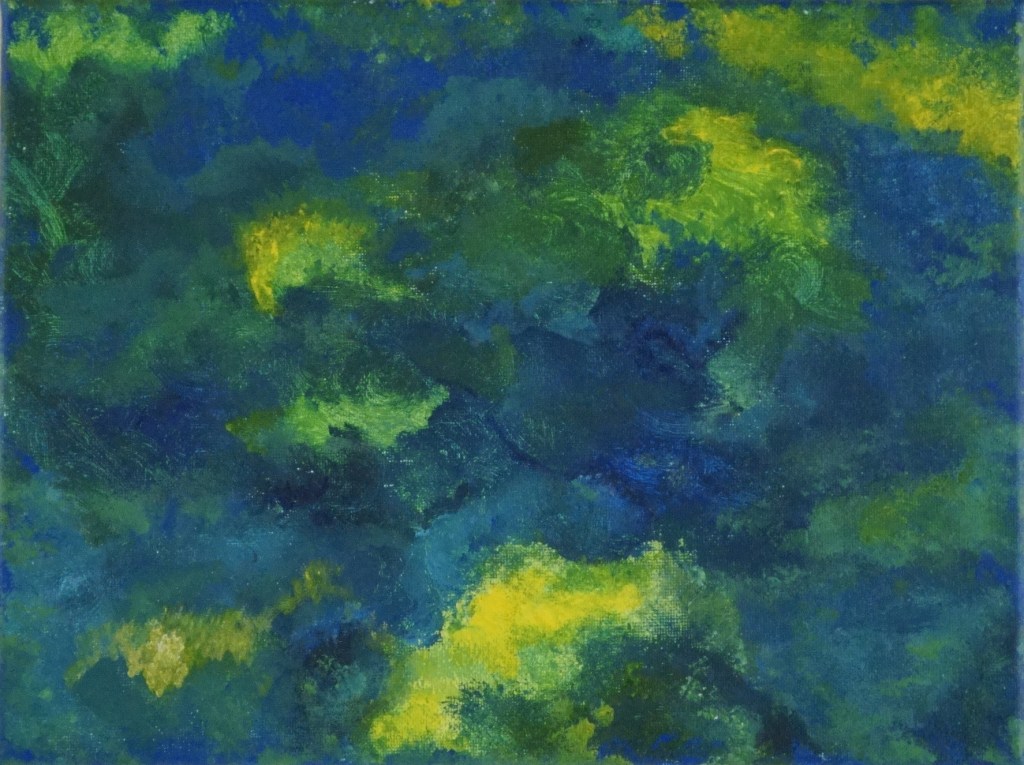
In Calm Flight of Imagination, Phoebe Trites creates a richly atmospheric field in which recognition remains beautifully unsettled. Painted in acrylic on canvas, this intimate 12-by-9-inch work does not present its subject through fixed outlines or descriptive details. Instead, it allows patches of blue, green, turquoise, and yellow to gather into shifting possibilities. A bird may be gliding through a deepened sky. A turtle may be swimming beneath the surface of an imagined sea. Neither interpretation fully claims the painting, and this uncertainty is precisely where its expressive power resides.
The work invites a slower form of looking. Rather than immediately identifying an object, the viewer must enter the painting’s visual environment and allow perception to become active. Dark blue-green forms accumulate near the center, producing a broad, ambiguous presence surrounded by luminous areas of yellow-green. Depending on how the eye follows its contours, this central formation may appear airborne, aquatic, or entirely abstract. Trites gives the viewer enough visual suggestion to awaken association, yet leaves sufficient openness for personal memory and imagination to complete the image.
Emotionally, the painting carries a sense of quiet immersion. Its dominant blues establish depth and contemplation, while the greens suggest natural growth, shadowed foliage, or underwater vegetation. Small passages of yellow and yellow-green introduce warmth without disturbing the overall calm. These brighter areas resemble light passing through leaves, clouds, or water, briefly illuminating a world that remains otherwise mysterious. The result is peaceful but not passive. There is gentle movement throughout the surface, as though the entire composition were breathing, drifting, or slowly transforming.
The arrangement of color creates an organic visual rhythm. Brighter clusters appear near the upper right, middle left, and lower center, guiding the eye through the composition without forming a rigid pathway. These areas of illumination are balanced by deeper blue and teal passages that create pauses and visual weight. The darkest central region becomes a kind of threshold, encouraging the viewer to look more carefully for the creature or form that may be emerging there. Although the composition is abstract, it retains the spatial sensations of landscape and nature, areas central to Trites’s wider artistic interests.
Trites’s acrylic technique contributes significantly to the painting’s ambiguity. The surface appears to have been developed through layered dabbing, brushing, and softly scumbled applications of pigment. Some areas are dense and opaque, while others allow underlying colors and the texture of the canvas to remain visible. These variations prevent the painting from feeling flat. They create a tactile atmosphere in which forms seem to emerge gradually rather than being sharply imposed. The softened boundaries between colors are particularly effective, allowing one shape to dissolve into another and reinforcing the sensation of movement through air, water, foliage, or dream.
This painting also reflects Trites’s belief in art as a place of healing and possibility. Her attention to fantasy, landscapes, and nature is present not as literal illustration, but as an imaginative language through which reality can be reconsidered. Her lived experiences have given her a distinctive sensitivity to how differently people perceive and interpret the world. In this painting, that awareness becomes an artistic strength. There is no correct answer waiting to be discovered. The bird and the turtle can coexist because the image belongs partly to the artist and partly to every viewer who encounters it.
As a young artist continuing her formal studio education, Trites demonstrates an encouraging willingness to trust suggestion, color, and intuition. Calm Flight of Imagination reminds us that seeing is never entirely objective. A shape may become a creature, a shadow may become a landscape, and a field of color may open into an entire interior world.
Readers are invited to explore more of Phoebe Trites’s evolving practice through her official website, follow @phoebetritesart on Instagram, and discover further examples of her work through her Biafarin profile page.


Leave a Reply