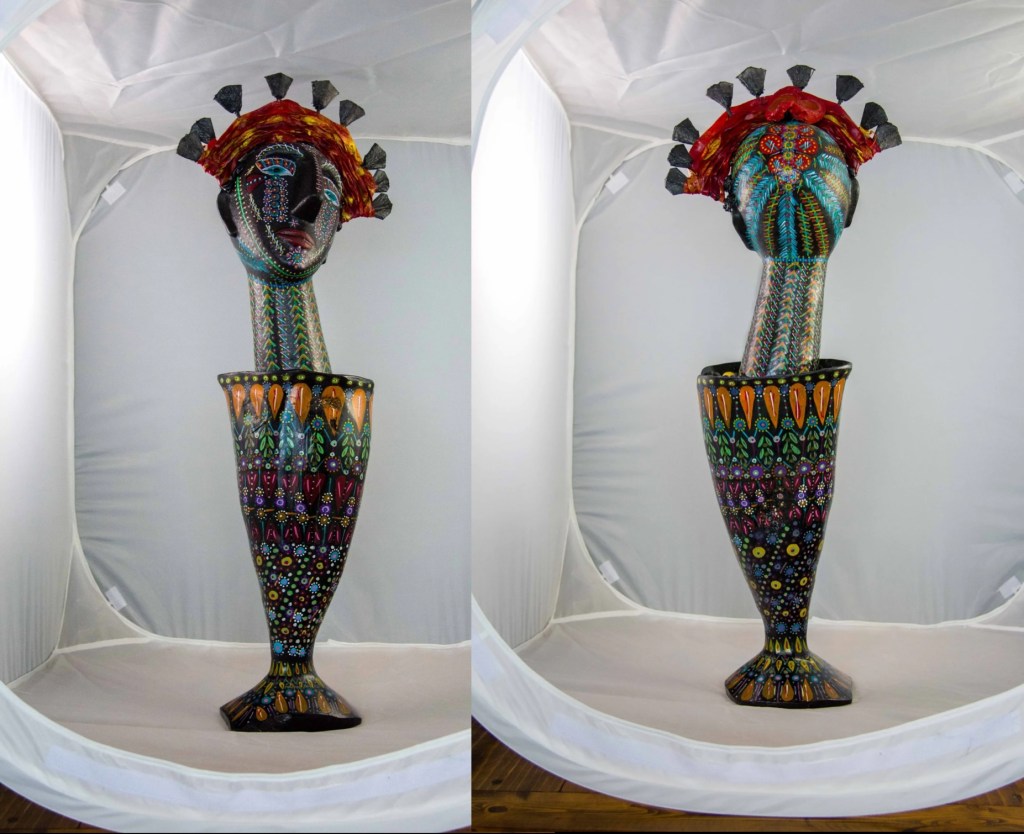
In a quiet yet commanding rise, she emerges not from history, but from within, a figure shaped by rhythm, adorned with thought, and crowned by the language of color itself.
JoAnn Teel’s Queen stands as a striking embodiment of presence, both physical and psychological. The elongated form, reminiscent of a ceremonial vessel, becomes a conduit for something far more human, a portrait of awareness, resilience, and quiet authority. The sculpture’s upward stretch draws the eye with intention, guiding us from its grounded base to the poised, contemplative face crowned in textured red. This ascent feels symbolic, as though the figure is not merely standing, but evolving, rising through layers of experience toward clarity and balance.
There is a stillness in her expression that does not suggest passivity, but rather a deep internal equilibrium. The artist’s description of enlightenment and rational understanding is not illustrated through overt symbolism, but instead through the harmony of visual language. The face, painted with intricate, symmetrical patterns in vivid turquoise, orange, and yellow, evokes both ritual adornment and neural mapping, suggesting thought, memory, and perception interwoven. The eyes, stylized and calm, anchor the viewer in a moment of reflection.
Color plays a central role in shaping the emotional resonance of the work. Against a black ground, the luminous palette, electric greens, bright oranges, vivid pinks, and cool blues, creates a dynamic contrast that feels both celebratory and intentional. These are not random embellishments; they are carefully orchestrated sequences that pulse with energy. The repetition of dots, floral motifs, and linear patterns across the surface creates a visual rhythm that echoes the artist’s neurographic approach, where process becomes meditation and pattern becomes language.
The body of the sculpture, resembling a vase, reinforces the idea of containment and transformation. It suggests that the figure holds something within, knowledge, emotion, or perhaps the very energy that radiates outward through its surface. The intricate detailing across this form transforms it from an object into a narrative space, where each motif contributes to a larger story of renewal and elevation. The use of assemblage further deepens this concept, as the work itself is born from reclaimed materials, now elevated into something ceremonial and dignified.
Teel’s background across multiple disciplines, fiber, metal, clay, and stone, is evident in the tactile richness of the piece. The crown, with its textured red surface and dark protrusions, introduces a sculptural contrast to the smooth, painted body. It feels both organic and constructed, a symbol of earned authority rather than inherited power. This queen is not ornamental, she is experiential, shaped by process, time, and intention.
Emotionally, Queen invites a sense of calm empowerment. It does not overwhelm, but instead draws the viewer into a quiet dialogue. The repetition of pattern becomes almost hypnotic, echoing the meditative state described by the artist. There is a sense that this figure has arrived at a place of acceptance, where imperfection is not hidden but integrated into a larger harmony. This aligns seamlessly with Teel’s philosophy that perfection is overrated; instead, beauty emerges through process, patience, and presence.
On a conceptual level, the work bridges personal introspection with universal themes. It speaks of transformation, not just of materials, but of mindset. Discarded objects become vessels of meaning, and repetitive gestures become acts of healing. The sculpture becomes both an object and an experience, inviting viewers to slow down, to observe, and to reconnect with the quiet rhythms within themselves.
In Queen, JoAnn Teel offers more than a figure, she offers a state of being, where color, pattern, and form converge into a celebration of mindful creation. Viewers are warmly invited to explore more of her work through her website, Instagram, and Biafarin profile, and to discover the vibrant world she continues to build through color, rhythm, and transformation.
 Review Me
Leave a comment