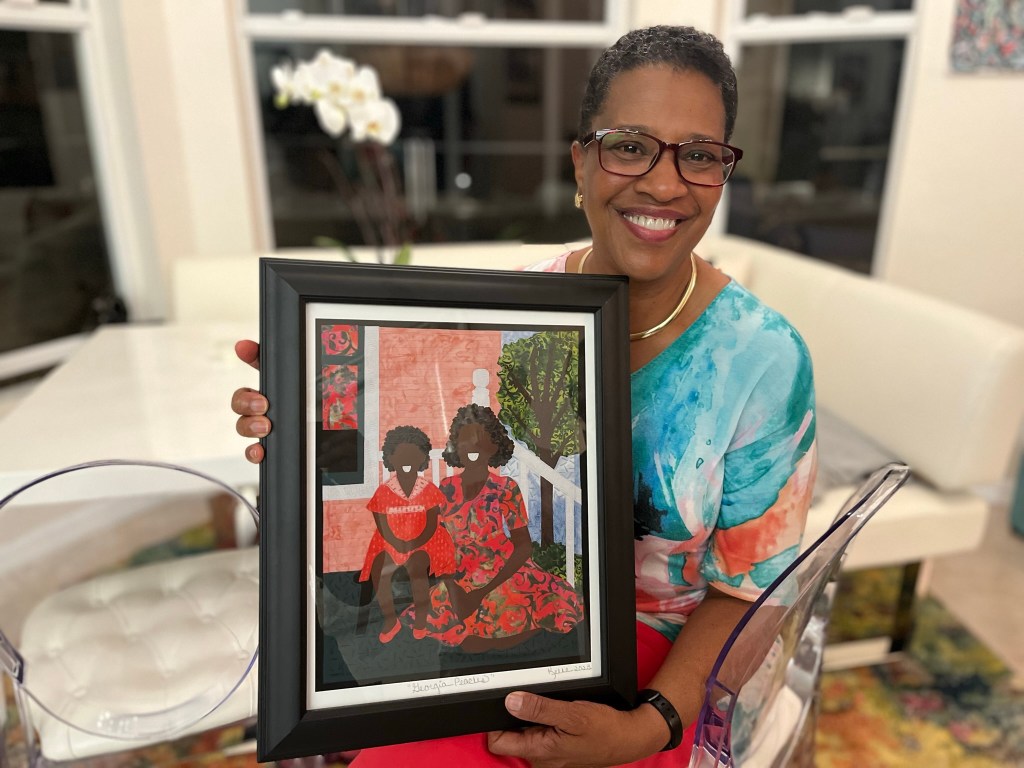
Hi Linda, thank you for joining us. Your work celebrates both heritage and everyday beauty through a rich tapestry of color, texture, and storytelling. Let’s begin at the moment everything shifted for you.
You spent many years in corporate marketing and later led a nonprofit. After retiring, you returned to something much more personal—art. What sparked your decision to pursue fabric-based art at that stage in your life?
With the extra time available to me in retirement, I found myself searching for something that would give my days the same sense of purpose I’d had in my professional life. I wanted to do something that would leverage my natural talents, expose me to new people and experiences, and provide meaningful opportunities for personal growth. I was also hoping to find an avenue through which I could realistically build a professional presence and earn recognition for my work.
Creating my own art was a natural outgrowth of a lifelong enjoyment of creative pursuits, and from more than two decades of collecting African American art. At this point in life, I wasn’t looking to spend years mastering a new medium before producing anything meaningful – I wanted to begin right away. My long history with fabric and sewing made the idea of “creating pictures with fabric” feel like the perfect fit. As I researched ways to do that, I learned about the discipline of art quilting, and it quickly became my focus.
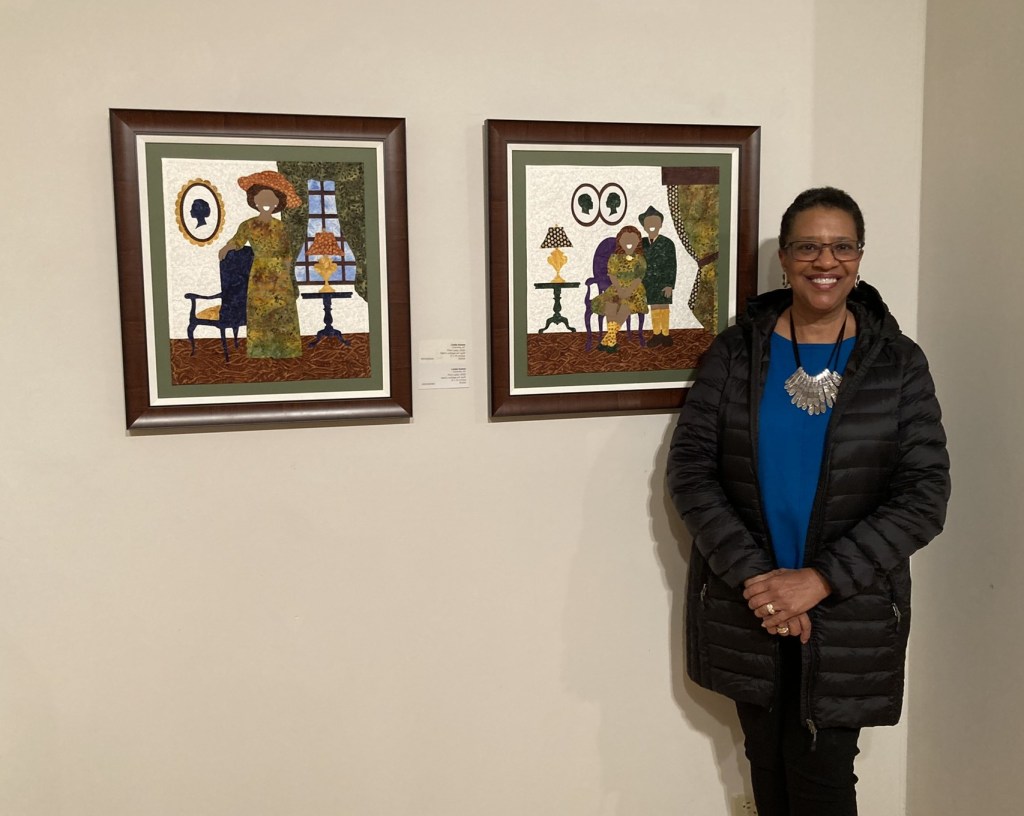
You’ve mentioned your love for drawing and painting as a child, but it wasn’t encouraged. How did those early instincts resurface and evolve into your current creative practice?
Over the years, I kept my creative instincts alive through hobbies like sewing, scrapbooking, photography, interior design, and art collecting. My career as a marketing executive also expanded those abilities in a professional setting. Product development taught me to think in terms of concept and execution; advertising and packaging design sharpened my sense of color, composition, and audience appeal. Today, my art practice brings all that experience together. I work primarily with fabric, using hand stitched backgrounds and embellishments like beading to add texture and visual interest. The instincts I have trained over decades help me intuitively balance color, pattern and form so that my finished art quilts are impactful and harmonious.
Can you walk us through your artistic process—from story development and concept boards to fabric selection and final stitching? For instance, how did a piece like “Wash Day” come to life?
My artistic process begins with the story I want to tell. I start by gathering reference material – sketches from my imagination, magazine clippings, online searches, and photographs. Recently, I have begun including AI-generated suggestions that add new visual possibilities. These become part of a concept board that outlines the key elements I will use to bring the story to life: figures, locations, wardrobe ideas, and props.
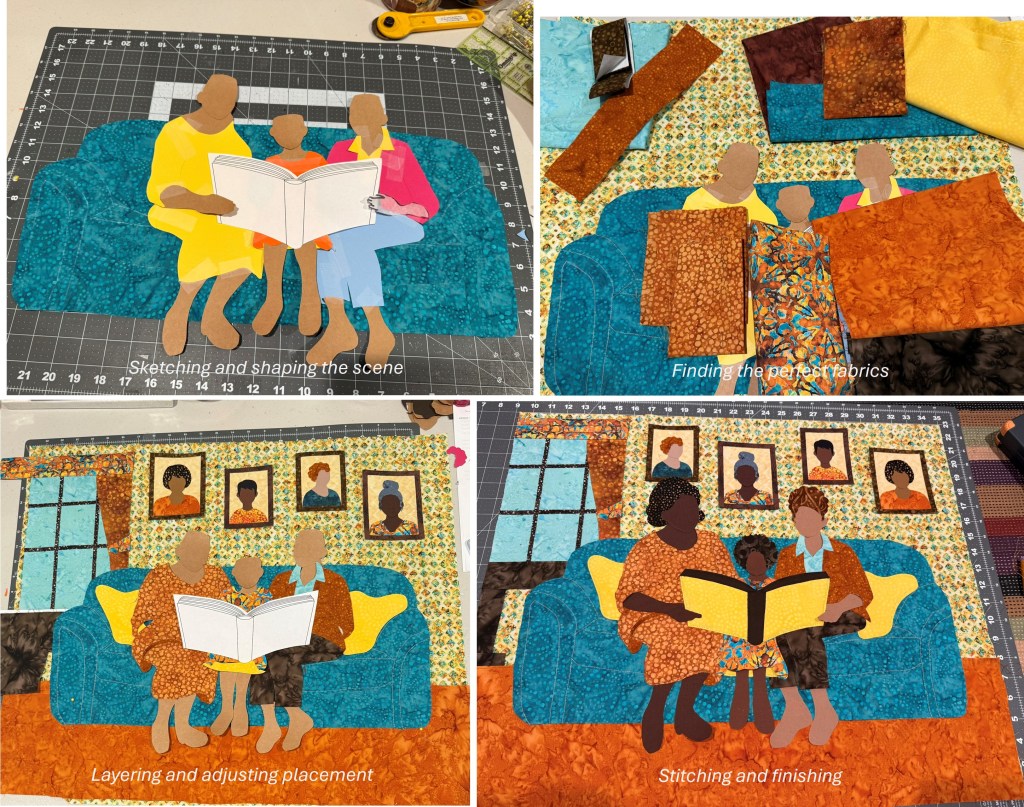
Once the concept board is complete, I create paper cutouts of the individual components and experiment with different arrangements. Working in paper allows me to move elements around freely – resizing, swapping, adding or removing them until the layout feels right. It is a cost-effective way to refine the design before cutting into fabric, which can be expensive.
With a final layout in hand, I select a color palette and gather the fabrics and embellishments I’ll need. Many come from my personal collection, but I often purchase a few additional items to achieve the right balance of patterns and textures.
Next, I cut out the pattern pieces and assemble the fabric “picture” that will become the quilt top. Complex backgrounds require careful attention to layering so that each element appears in the correct order. For example, if a tree sits behind a fence inside a yard, the fence is sewn first; if the tree is outside the yard, it’s sewn first with the fence layered over it. The main assembly is done by machine, but I hand-stitch areas of the background to add texture and depth. Finally, the completed quilt top is layered over batting (the insulation layer) and a coordinating backing fabric. These layers are bound together to create the finished art quilt.
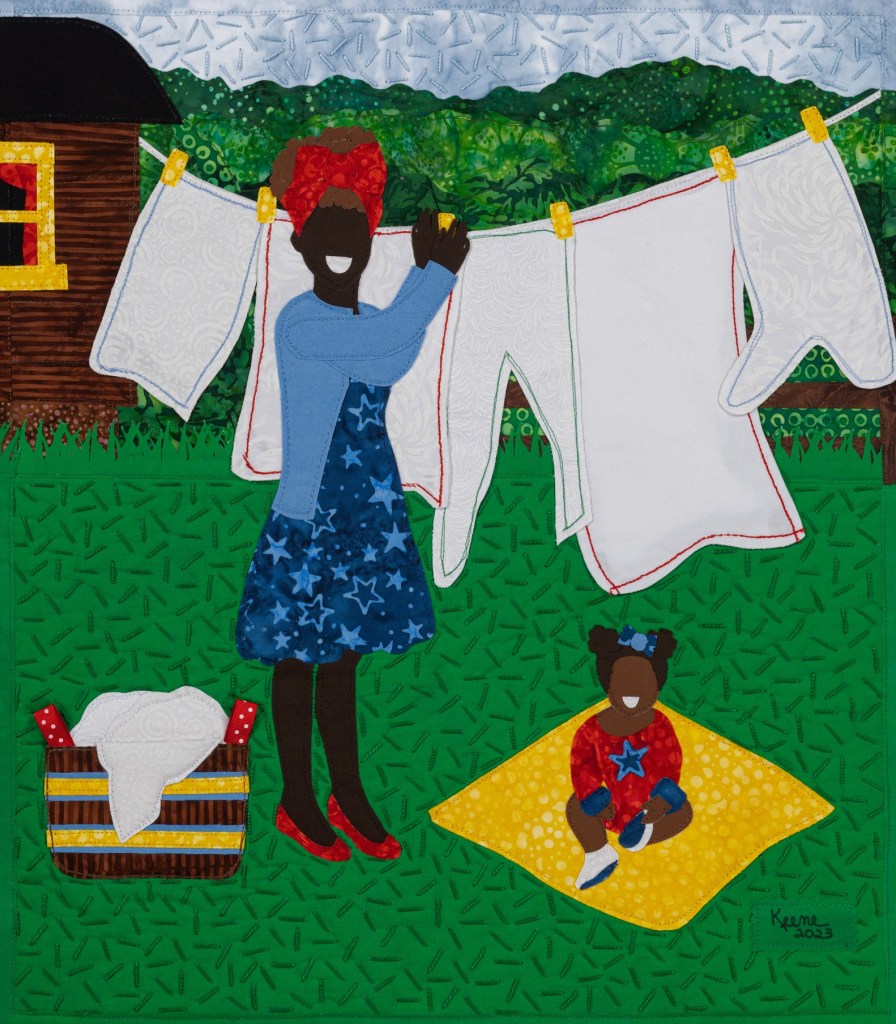
When creating “Wash Day,” I set out to capture the nostalgia of freshly washed laundry drying outdoors. Although doing laundry was a tedious chore in the days before home washing machines and dryers were available, the scent of sun-dried clothes and bedding often evokes fond memories of simpler times.
I wanted to place the scene in the mid-20th century, so my concept board featured photographs of 1950s women in house dresses. Research also revealed small authentic details, like the head scarves African American women often wore to protect their hair while doing chores. Other reference images showed clotheslines swaying in the breeze, baskets overflowing with laundry, and a simple wooden house.
Originally, the design showed only a woman at work, but I decided to add a small child to create a warmer, more dynamic scene. The woman’s smile, prompted by the child’s delight in the sunshine, shows a fleeting moment of joy in the middle of routine labor. This concept naturally suggested a vibrant color palette: crisp white laundry against a bright green lawn, trees in deep green, a clear blue sky, and the woman’s blue dress. Additional touches included brown siding and fencing, a black roof, and cheerful accents of red and yellow. Hand quilting stitches added texture to the sky and across the wide sweep of lawn, bringing depth to the scene.
Your use of vibrant fabric choices and layered textures gives your work a lively, almost musical rhythm. In a piece like “Going to Market,” how do you select fabrics? Do they influence the story, or does the story come first?
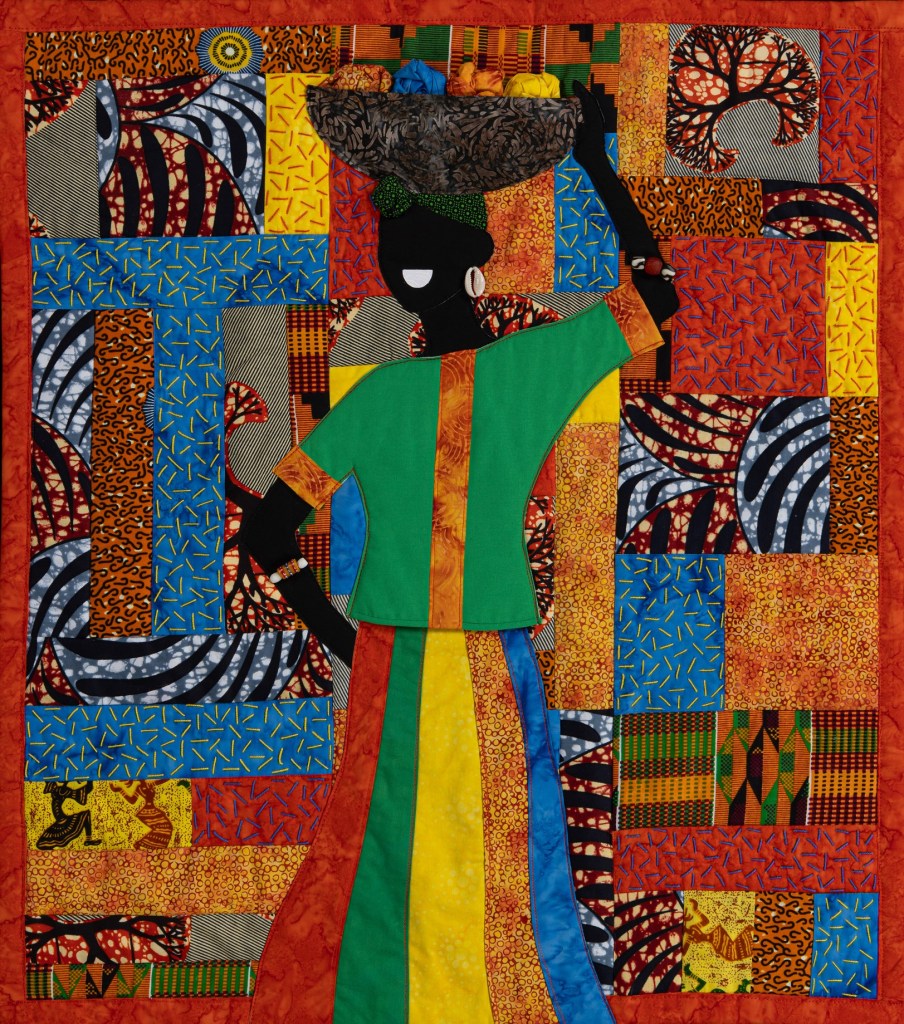
I maintain an extensive collection of fabrics purchased for their potential – textures that might suggest hair, wood, grass or sky. I also acquire prints featuring harmonious color combinations that are versatile enough to incorporate into clothing, home decor, or other background components.
Usually, it is the story that drives my quilt designs, with fabrics chosen to support rather than stand out individually. I begin by selecting a color palette and then experiment with fabric swatches from my collection until satisfied with the blend of patterns and textures. Of course, not every fabric works out as expected once it is incorporated into a piece. When this occurs, I replace it with one that creates a more balanced composition.
Sometimes, though, a fabric itself sparks a story. That was the case when a friend gave me a stack of African batiks. I do not usually work with fabrics having such bold patterns and was both challenged and inspired to find a way to use them to best advantage. The boldness of the patterns pushed me to simplify other elements, letting the fabric’s energy drive the narrative. For “Going to Market”, I chose fabrics with vibrant reds, greens and yellows to bring life to the concept of a bustling marketplace. From these fabrics, I created a background using simple shapes laid out in a pattern to represent the roads leading to the marketplace. Given the complexity of the background, I chose to go with a single large central figure dressed in solid colors and minimal embellishments to keep the piece balanced.
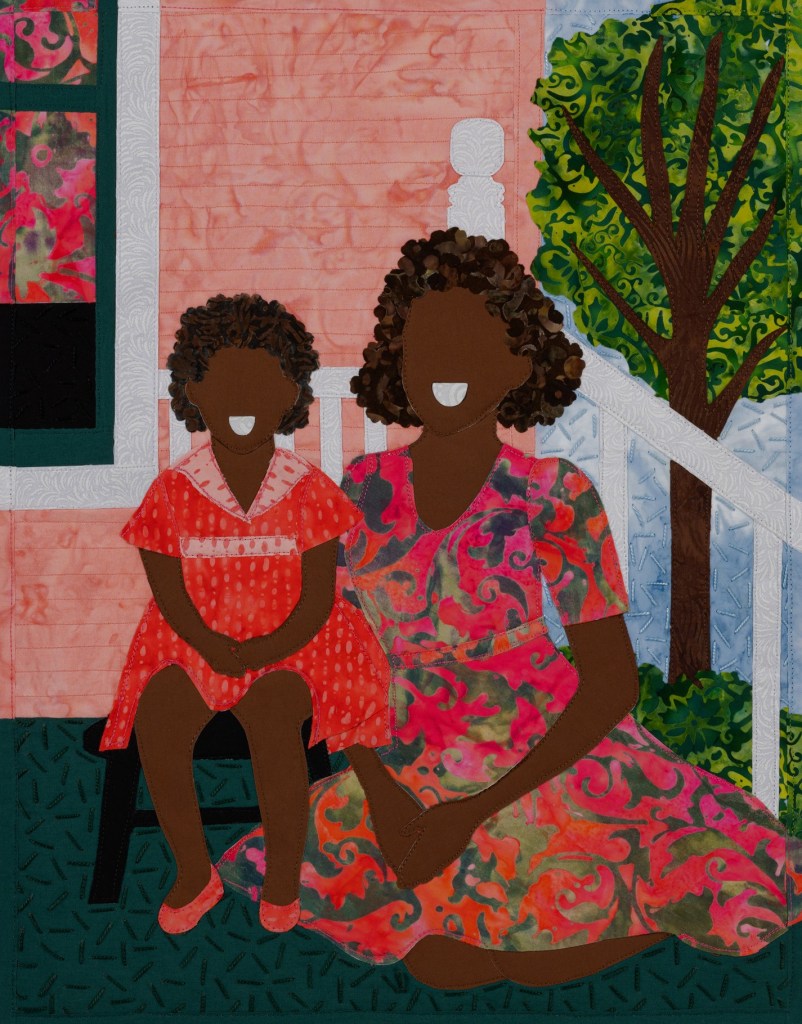
Your work radiates warmth, joy, and cultural affirmation. You often depict smiling figures and themes of family, faith, and shared experience. How intentional is that emphasis on positivity in your storytelling?
As a collector, I have consistently been drawn to vibrant artwork that radiates energy and celebrates the resilience of African-American life. Having my home filled with these images over the years has been a source of comfort and motivation in my personal journey.
In my artwork, I aim to evoke that same uplift in others. Consequently, I focus on themes such as family, faith, and shared cultural experiences that bring people together and affirm our humanity. I intentionally refrain from exploring themes rooted in trauma such as slavery, discrimination, or police brutality. While those subjects are important, I feel they are already powerfully represented by other artists, and I don’t have something new or distinctive to add to that conversation.
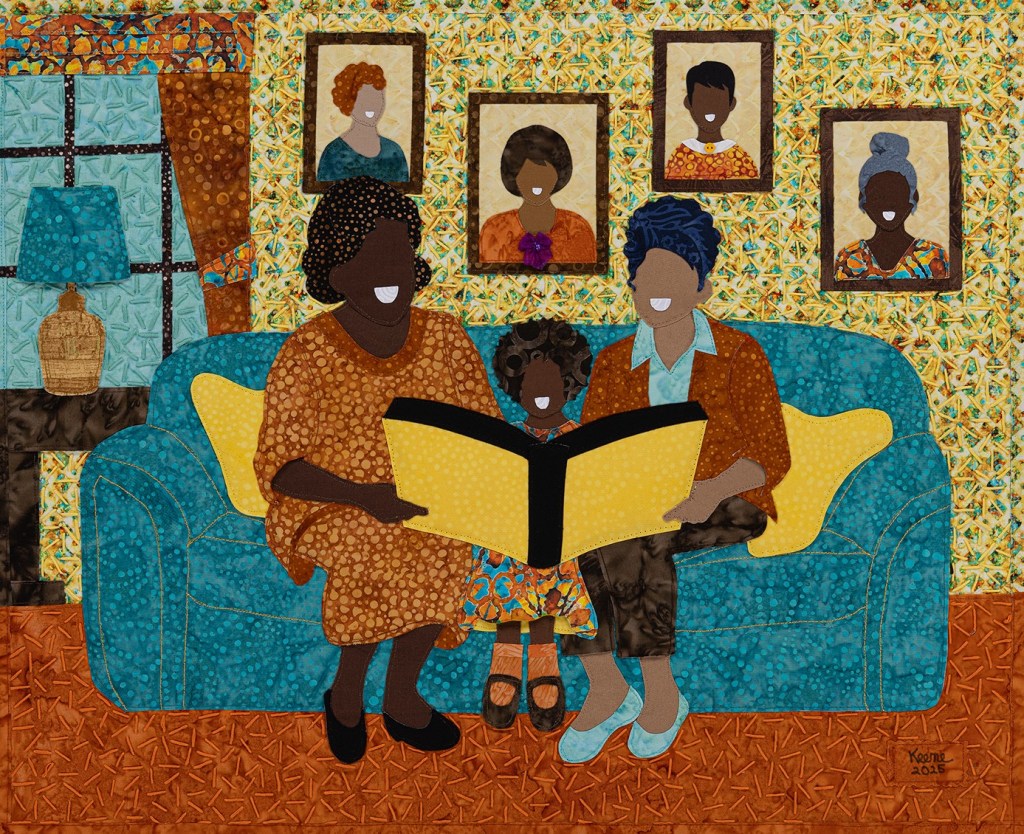
Family history plays a powerful role in your work, from “First Lady” to “Sharing Our HER-story.” How have ancestry, archival photographs, and oral tradition shaped your creative vision?
I have been researching my family history for almost 30 years. My journey began with my paternal uncle, who was inspired by Alex Haley’s “Roots” to start tracing our lineage in the late 1970s. For many years, I worked alongside him with my main contribution being introducing technology into the process – digitizing his handwritten family trees, organizing the data and making it shareable.
After my uncle passed away in 2014, I took on the role of family historian. DNA has enabled me to verify links to families who enslaved our ancestors – stories that were part of our oral history but previously unproven. I have now traced both sides of my family back to the 1800s and maintain a remarkable collection of black and white photographs of my ancestors from the late 19th and early 20th centuries.
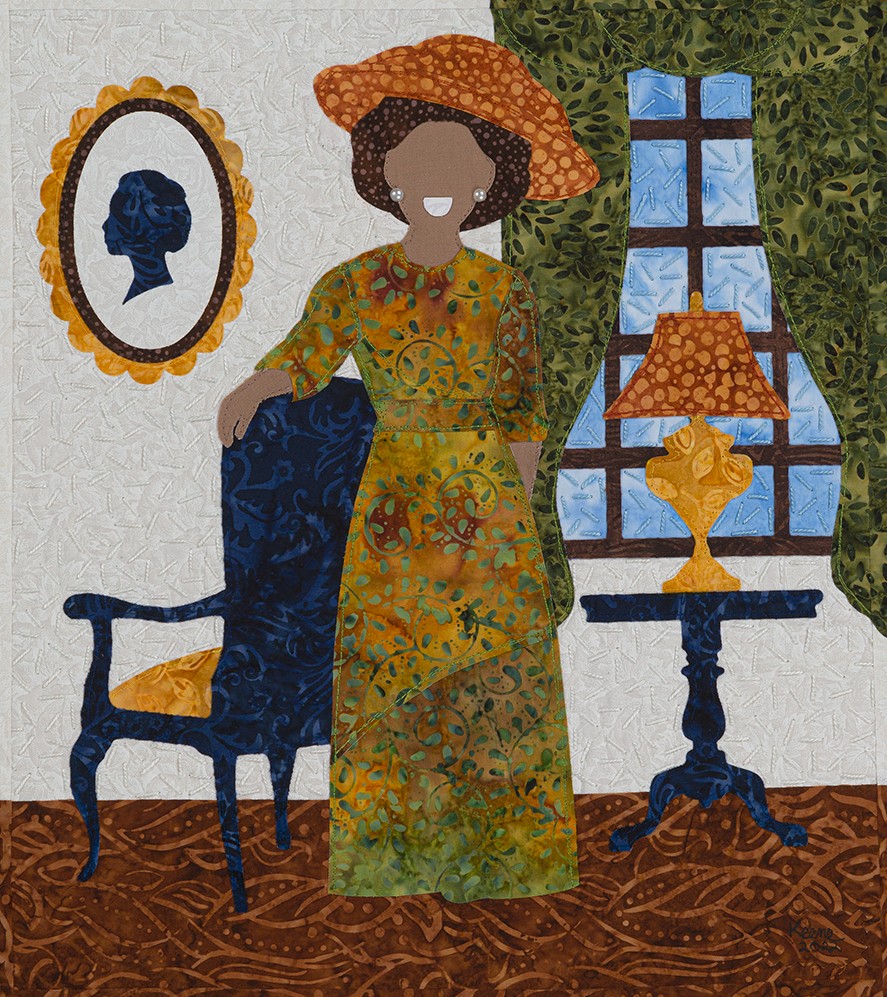
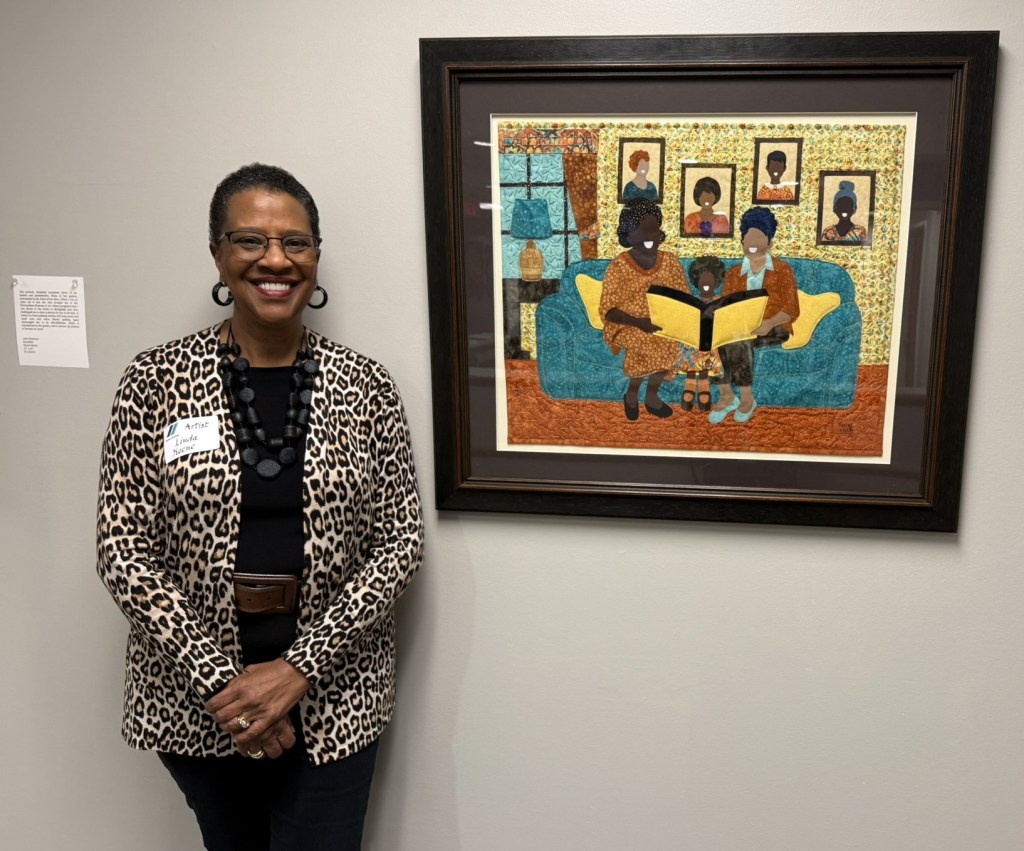
Understanding my family’s history has been a rich source of inspiration for my artwork. “First Lady” is part of a series which attempted to bring old B&W photos “to life” with vibrant fabrics, creating pieces that evoke not only personal memories but also universal experiences. “Sharing Our HER-story” draws inspiration from the tradition of oral history, which serves to preserve African-American family narratives that may otherwise be overlooked by mainstream society. In this piece, the grandmother is committed to ensuring that future generations gain an understanding of the lives and contributions of their female ancestors. Works like these have resonated with viewers, many of whom see reflections of their own family stories in my art.
You’ve described your hand-stitched backgrounds as tributes to generations of women quiltmakers in your family. How do you see your work as a continuation of that legacy?
I grew up watching my maternal grandmother making quilts by hand. I remember her always being busy – cooking, cleaning, taking care of her home and many grandchildren. When she did have time to sit down to watch her favorite soap operas, her hands were never idle, and she would often be working on a quilting project. She would take old pieces of clothing, bed sheets and other leftover pieces of fabric, cut them into shapes, and hand-stitch them together to make quilt tops. She never followed a pattern, but somehow the pieces came together to make something that was both functional and beautiful. My grandmother did not consider herself to be an artist – her quilts were made for everyday use and got lots of wear. Because of this, only a few examples of her work have survived to the present day.
Quilting was a practical craft that my grandmother and generations before her passed down because it allowed them to stretch their limited budgets. I first began sewing as a teenager for the same reason. I liked to dress nicely and did not have a lot of money to spend on clothes. I found that I could have a much larger wardrobe if I made my own. Those sewing skills served me very well through high school, college and the early years of my career.
At this stage of my life, my sewing skills have been a vehicle for launching a new career as an artist. Incorporating hand-stitching into my artwork isn’t just decorative, it is a connection to the resourcefulness of my female ancestors.
Works like “Heading North” reference the Great Migration, while “Going to Market” celebrates African identity and tradition. How do you approach balancing historical grounding with imagination in your work?
I approach cultural history as a search for themes and imagery with historical grounding and broad resonance. Except in pieces that recreate family photos, my works are imagined scenes anchored in authentic details.
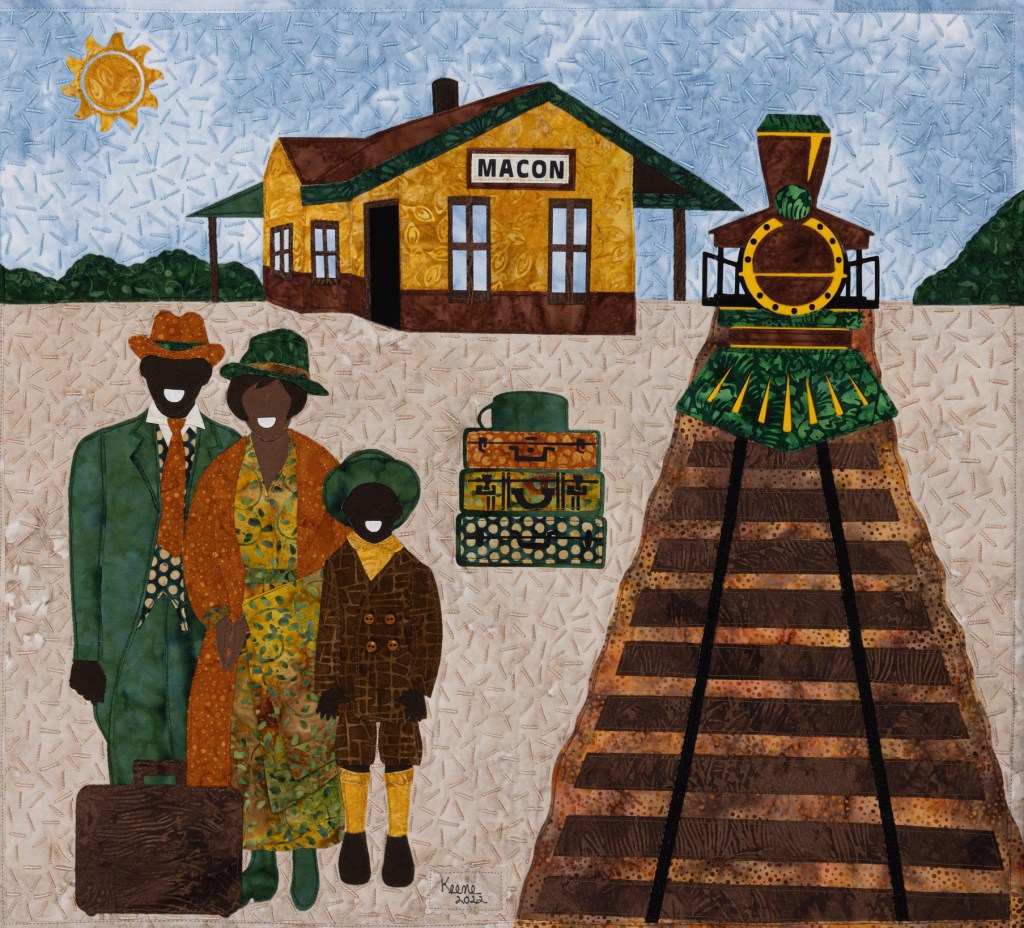
In “Heading North”, for example, an African American family is dressed in their Sunday Best as they leave the Jim Crow South for better opportunities. This reflects a real historical practice of using formal dress to counteract racist stereotypes and project dignity at a time when negative perceptions about African Americans were dominant in mainstream white society. In “Going to Market” the central figure carries a basket on her head as she walks to the marketplace. In many African societies, women are responsible for gathering food, fetching water, and selling goods – tasks that often involve transporting items. Girls learn from a young age to balance loads on their heads, a skill tied to regional identity and expressed through distinct styles of baskets, head wraps, and walking techniques. Having the central figure depict this practice honors a broadly relatable tradition.
“Doing the Bump” and “Detroit Divas” feel like celebrations of rhythm, fashion, and cultural pride. What inspired you to explore the connection between music, dance, and fiber art?
Music and dance are both integral parts of the African American cultural experience, so it felt natural to explore these themes in my artwork. As a teenager in the 1960s, I spent hours watching American Bandstand, Soul Train, Shindig, and Hullaballoo, dancing to Motown hits, and admiring the style of those performers.
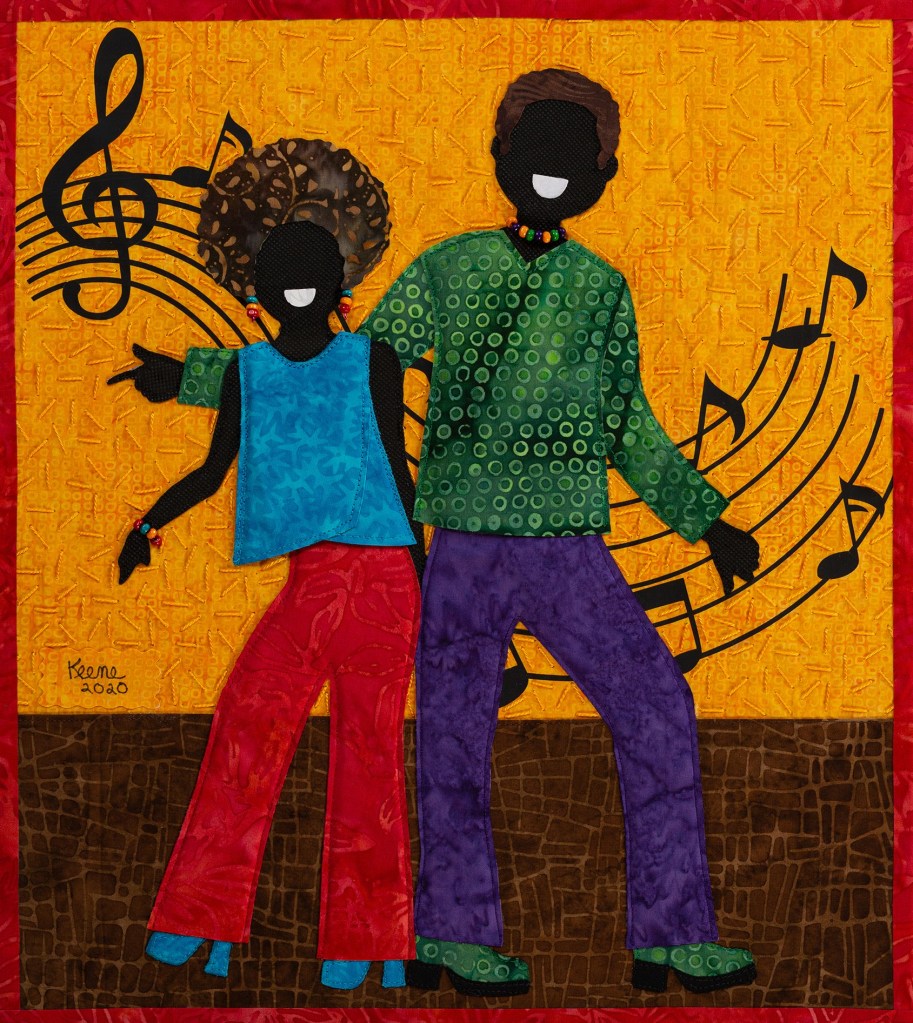
“Doing the Bump” was one of 4-part series on couples dancing. Each piece in the series was executed in bright colors and used a musical staff in the background to help convey a sense of movement. It was my first juried show acceptance and sold on opening night to a collector who said the piece reminded her of her college days.
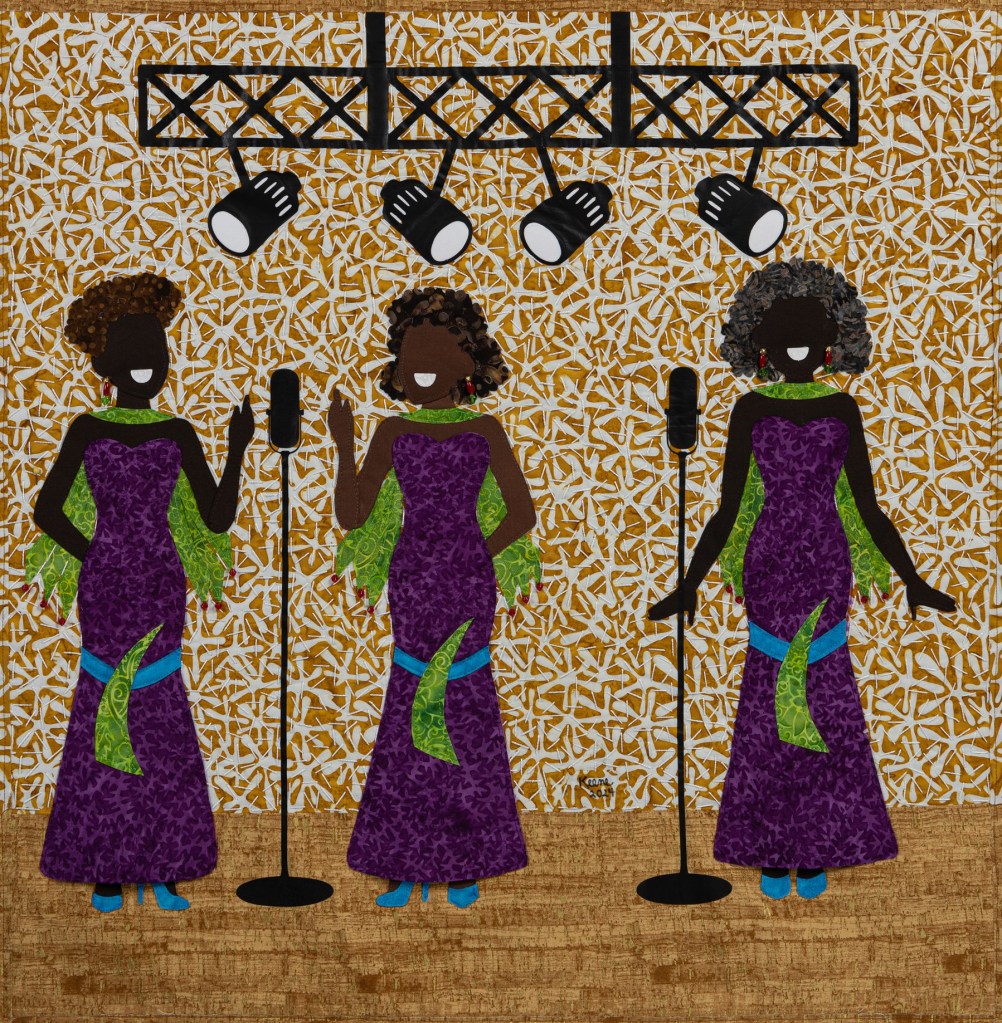
“Detroit Divas” was created in response to an art call for a 2024 show with the theme “A Celebration of Black Music”. The exhibition was sponsored by the City of North Charleston Cultural Arts Department, which holds an annual showcase featuring the work of African-American art quilters. “Detroit Divas” was juried into the show and was featured in the advertising and promotional materials. I was so inspired by all the interpretations of the theme that I saw at the show that I did three additional music-themed pieces after returning home.
You’ve spoken about artistic lineage beyond your family as well. Who has influenced your journey as a fiber artist and storyteller?
I see myself as part of a lineage of African American visual storytellers who celebrate our culture and traditions through art. I’ve always gravitated toward colorful, expressionist work rather than realistic depictions. That preference has drawn me to artists like Jonathan Green, William Tolliver, Leroy Campbell, and James Denmark all of whom are represented in my personal collection.
I feel a deep kinship with the work of Faith Ringgold, a pioneer in the use of fiber arts to tell both personal and collective African American stories. Her story quilts, paintings, and mixed media pieces helped legitimize this form of expression within the broader art world. I also admire Bisa Butler, whose stunning fabric portrait quilts reimagine historical photographs of African Americans. Her 2021 solo exhibition at the Art Institute of Chicago was a landmark moment for establishing art quilts as fine art.
I also admire Carolyn Mazloomi (founder of the Women of Color Quilters Network), and Cookie Washington (who launched the annual City of North Charleston African American Quilt Festival) who have played crucial roles in elevating African American quiltmakers’ curatorial work and building artist networks.
Locally, I’m fortunate to be part of a community that includes two nationally recognized mixed media artists who also center African American history and use fabric extensively in their work. Beverly Smith, a classically trained artist, combines traditional quilting with graphite drawings, photographs, and artifacts to create stitched collages reflecting the Black experience. Nellie Ashford, a self-taught folk artist, captures scenes and themes from life in the Jim Crow South. Like me, Nellie began her artistic journey later in life—her success has been a true source of inspiration.
Your work has received museum inclusion, juried exhibition placements, and publication features. What does that recognition mean to you as a self-taught artist?
A common thread throughout my life has been a drive to excel in whatever I take on. As a student, I took pride in academic achievements—making the Honor Roll, earning scholarships, and gaining admission to a top-tier MBA program at a time when very few women or people of color were being accepted. In my career, that same determination led to strong performance reviews and steady advancement, often as one of the first African American women to rise through the ranks in my organizations. Even in my hobbies, I’ve always committed to learning and mastering new skills. I’ve long believed that if a job is worth doing, it’s worth doing well.
As a self-taught artist, earning professional recognition for the quality of my work feels like affirmation that I’m on the right path and my efforts are paying off.
In today’s interconnected world, how have platforms like Biafarin expanded the visibility of your work?
Having exposure through online platforms like Biafarin, Gallerium and Exhibizone has extended the reach of my work to far beyond my region. About a third of my original art sales have come from customers who first discovered my work online. I have also been invited to participate in podcasts based on that exposure. While my focus is still African American culture, I’m now beginning to explore themes across the broader African diaspora.
Lastly, what advice would you offer to women—especially those who come to art later in life—who are still finding the courage to claim their creative voice?
There are so many entry points available to artists today – local artists groups, online platforms, local and regional art fairs and competitions make it possible to reach an audience without waiting for a gallery or museum to “approve” you. My advice is to get your work out there so it can find an audience. Be clear about the contribution you want to make and learn to tell the story of your work. As someone who is both self-taught and a late-bloomer, I have found the art community to be incredibly welcoming especially when you can communicate your vision with clarity.
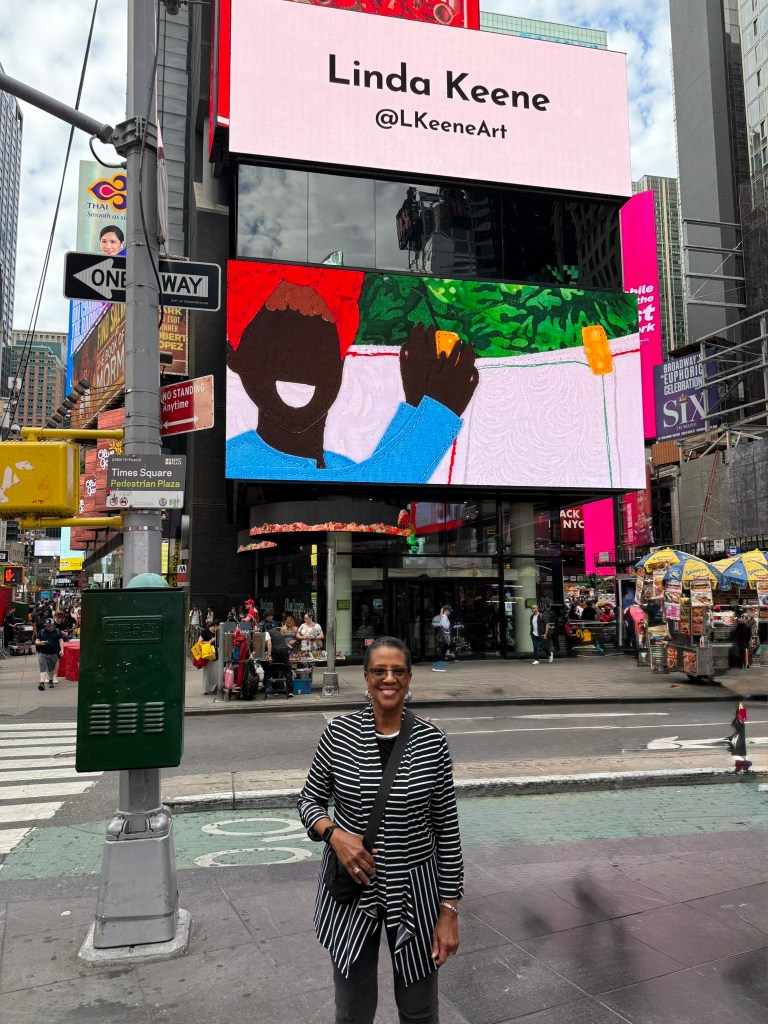
To explore more of Linda Keene’s vibrant fiber art, visit her website, follow her on Instagram, or explore her Biafarin artist profile. Stitch by stitch, her work honors generations of women, uplifts cultural memory, and celebrates the resilience and joy woven into African American life—reminding us that our stories deserve to be seen, shared, and treasured.
 Review Me
Leave a comment