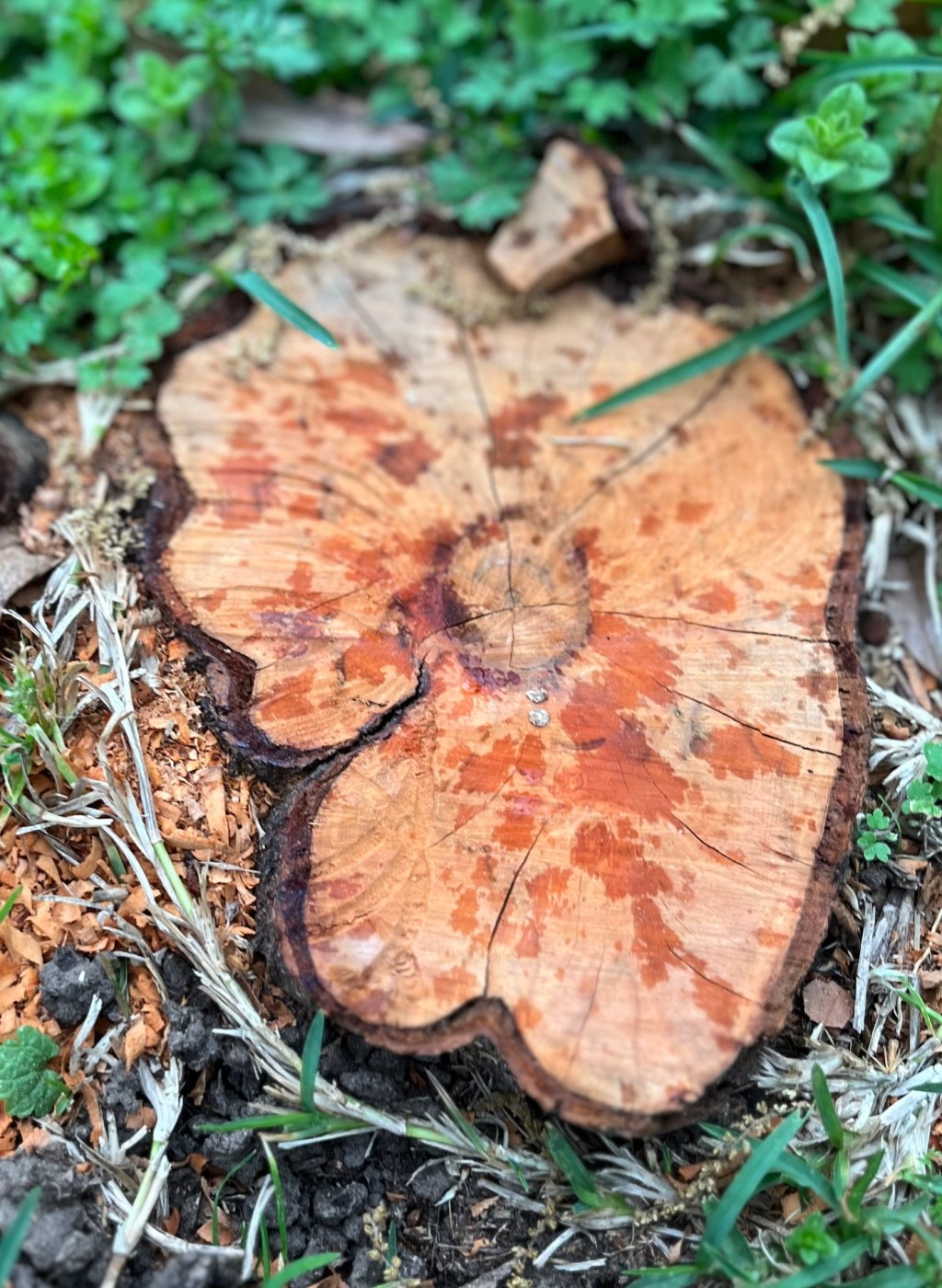
In the quiet language of the earth, endings are never abrupt. They are etched in rings, soaked in rain, and whispered through time. Elizabeth Miller’s A Life Cut Short captures one such tender farewell: the truncated life of a tree, resting now among blades of grass and clover, its heartwood glistening with what the artist calls “raindrop tears.” Through her lens, Miller transforms an ordinary stump into an elegy for resilience interrupted, a visual poem of beauty, loss, and reverence.
At first glance, the photograph may seem simple—a cross-section of a felled tree, its sap-stained core marked by age and weather. Yet, the more one looks, the more its stillness speaks. The tree’s organic curves seem to pulse faintly with remembered life, while the warm amber tones of its interior, mottled with russet stains, evoke both vitality and decay. Miller’s camera does not mourn loudly; it grieves in whispers. The image reminds us that even in loss, there is grace, and that nature, in its infinite patience, never truly ends but transforms.
Color plays a vital role in Miller’s emotional storytelling. The soft reddish hues bleeding through the wood recall the pulse of life that once coursed through its veins. They contrast with the cool greens encircling the stump—small plants reclaiming the space, continuing the cycle. This interplay between the warmth of what was and the renewal of what remains lends the composition its quiet tension and emotional resonance. It is not simply a record of death but a meditation on continuity, on how the natural world absorbs sorrow and gives it back as growth.
Miller’s eye for detail is both intimate and deliberate. Her shallow depth of field draws the viewer’s gaze inward, focusing on the scarred heart of the stump while allowing the surrounding foliage to dissolve softly into blur, a visual metaphor for memory fading at the edges. The composition feels instinctive yet balanced: the curve of the bark, the tender greens creeping in, the fractured center aligned with the viewer’s line of empathy. There is a painterly sensibility here, perhaps inherited from Miller’s background in painting, evident in the way texture and tone weave together to form a tactile narrative.
At its core, A Life Cut Short echoes Miller’s broader artistic philosophy—her desire to honor the overlooked beauty in familiar places. In this work, a fragment of her backyard becomes a mirror for the universal. We are reminded of our human tendency to control, to prune, to decide what stays and what goes. Yet within that act of removal, Miller finds poignancy rather than protest. Her framing turns a mundane decision—a property owner cutting down an unwanted tree—into a meditation on coexistence and impermanence.
The work stirs reflection rather than despair. The “raindrop tears” feel like nature’s gentle mourning but also its cleansing. There is something profoundly human in how the stump, though lifeless, still breathes warmth through its color and shape, holding memory in its rings. It evokes not only ecological empathy but also personal contemplation: how we, too, are marked by time, shaped by circumstances beyond our control, and eventually folded back into the greater living fabric.
Rendered with quiet precision, the photograph reveals a mastery of natural light and texture. The soft daylight enhances the tonal range, revealing both the roughness of the bark and the smooth planes of the cut wood. Miller’s use of close-up perspective turns this small patch of earth into an expansive landscape of feeling. Her restraint—no filters, no exaggeration—amplifies the authenticity that defines her growing body of work.
Through A Life Cut Short, Elizabeth Miller continues her exploration of nature’s quiet narratives, transforming an act of destruction into a story of gentle endurance. It is a work that asks us to pause, to see not just what has ended, but what still breathes around it.
To experience more of Miller’s heartfelt perspective and discover her evolving journey through nature-inspired photography, visit her Instagram and Biafarin profile pages.
 Review Me
Leave a comment