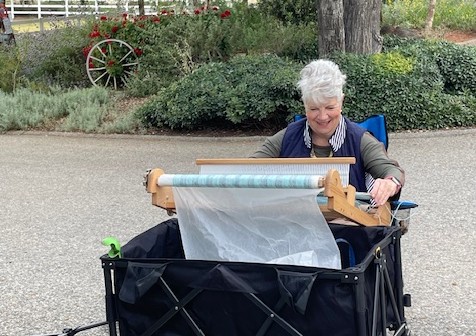
Thank you, Robin, for joining us for this interview. Your work beautifully blends texture, color, and storytelling, creating shawls that capture the essence of nature’s beauty. We’re excited to learn more about your artistic journey and inspirations.
With your background in fundraising, what first drew you to fiber arts—especially weaving and knitting? Was there a moment that inspired you to shift from nonprofit work to creating shawls?
Fundraising too is creative, from designing multiple methods for asking for money to unique ways to thank donors to devising new events to attract supporters. I’ve organized fundraising poker tournaments, fashion shows, band-aid balls, burger nights, mystery murder dinners and so many more. But fiber is something you hold with your hands. Touch the fiber and see if it is strong, soft, luxurious. How does the color mesh with other hues? Is it “friendly” to the face and complexion?

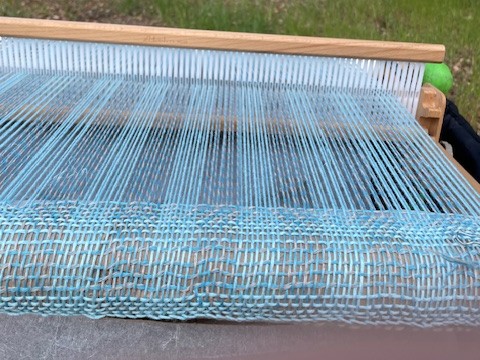
I began as a knitter when I was young, but lost interest, then a friend enticed me to take knitting lessons. I believe I joined mainly for the camaraderie. After dozens of lap ropes for the elderly, slippers for family and friends, baby blankets for countless newborns, and scarves for the homeless I again strayed from the craft. A former knitting instructor came back into my life and our conversation took me slowly “down the rabbit hole” to immerse me in weaving. I set up my business, Robin’s Nest Fiber Arts, to probe this art medium and becoming a colorist. That was 4 years ago, and now I simply cannot tolerate being without my loom. I love to weave and listen to an audible book, music or simply the birds while weaving for hours.
I just recently returned from 3 weeks at an artists’ apartment, La Maison de Beaumont, in the south of France. In 6 apartment units, artists come together to do their work, whatever their passion. There were painters, sculptors, writers and one lone fiber artist. The owner had never hosted a fiber artist. But I was overjoyed and inspired to be in this small village, with cobble stone and brick streets, amongst the other talents!
Your journey from community-centered creativity to hands-on fiber work is so vivid—and it’s clear how deeply connected you are to the process now. You’ve mentioned that nature, especially your morning walks, plays a big role in your inspiration. How do colors and textures from those moments—like a sunlit field or a deep blue sea—make their way into your shawl designs?
Scenery is always enticing! As a walker, all of my products are inspired by nature, all have nature related names or references, and all are photographed outside with nature as a backdrop.
I enjoy nature, and as my name references nature, Robin, and my company name too references nature, Nest, it is here I find my inspiration. I search out a color and from there meld companions with the base. Then adornments, inclusive of charms, buttons or beads, can be added. Many times, I will conjure up a name while in the weaving process, and quickly write it down. Sometimes though I wait for a name to emerge after the piece is complete.
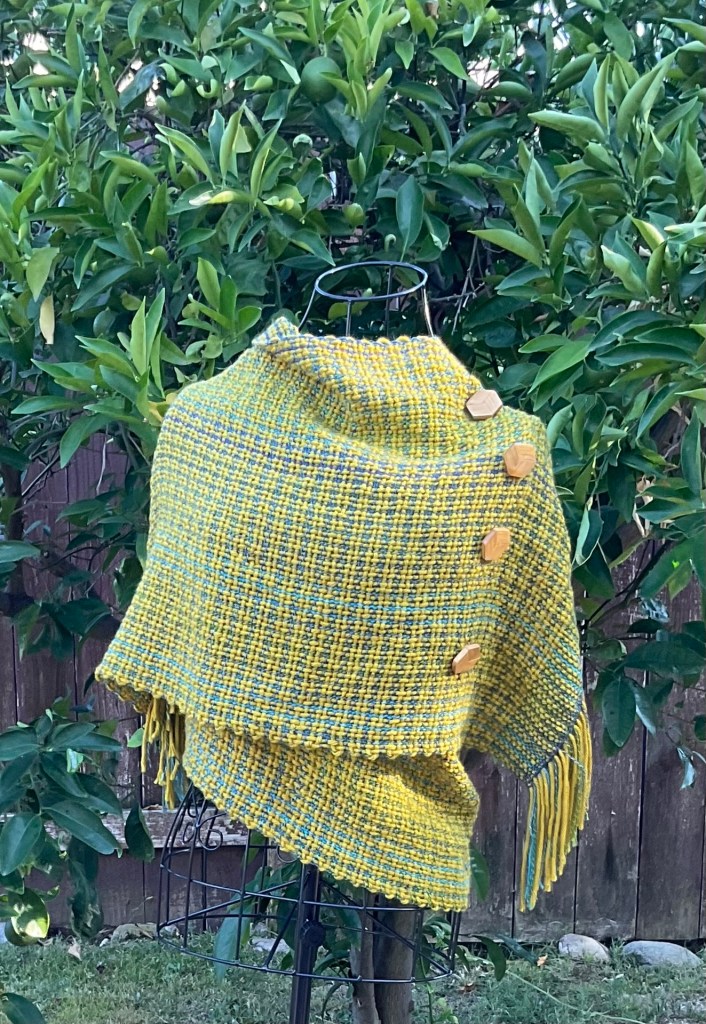
Unbelievable though it is, I recently reviewed a piece realizing it was missing the buttons. As I looked at the shawl it struck me that it resembled a fire. As an evacuee of the Pasadena Eaton Wildfire, one of the very first groups, subconsciously the flames came back! I recently submitted it for display at a tribute to the community.
It’s moving how memory and nature come together in your work—like the wildfire piece. When it comes to actually creating each shawl, how much do you plan ahead? Do you map out the colors and patterns in detail, or does the design evolve spontaneously as you weave?
Combination is a simple answer: improvise and plan! I know what is required for a shawl to have flow, from length to width to texture. That is what is important. As a woman or wearer walks, the shawl must glide with one’s self. This contributes to the elegance of the wearer, what is a shawl without a wearer, and the gliding motion highlights the pattern in the piece. By adding perhaps some lace or increasing the size or purposefully placing the ornamentations the piece can better float. While in process, though, it is not uncommon to decide not to add that color, redo a section or simply, start over as I have done. That yarn perhaps may have been meant for another project.
That movement gives your shawls so much life—like each one has its own personality. When starting a new shawl, what usually guides your choices—emotion, season, or the materials themselves?
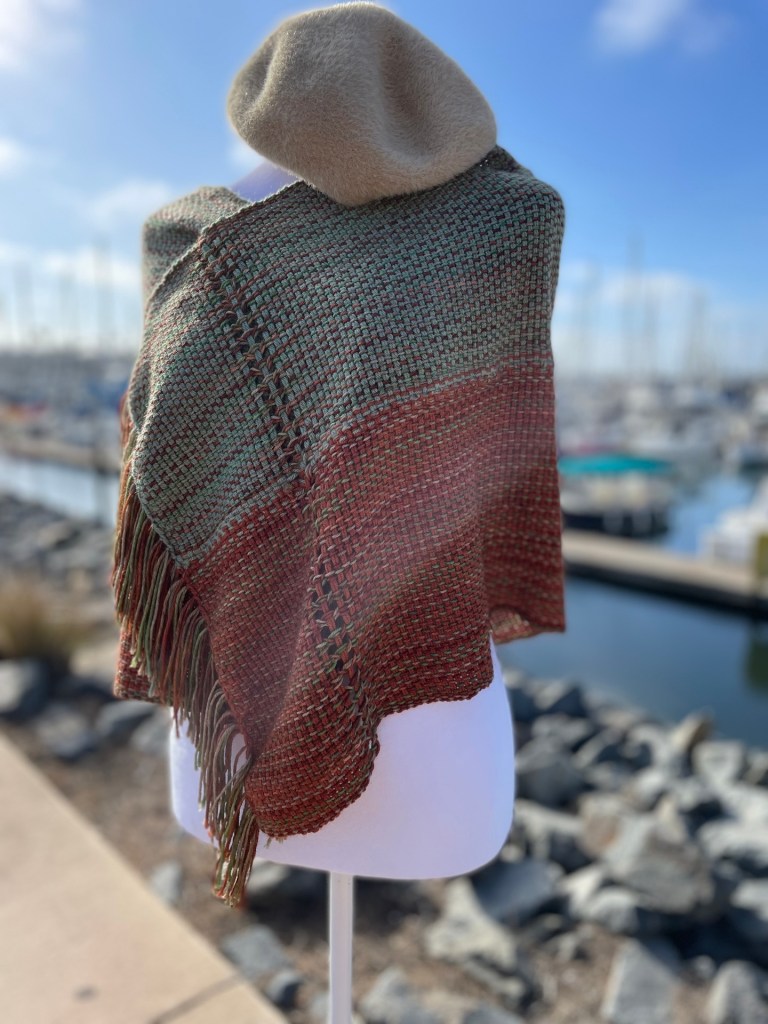
The design process is intriguing. It can take hours or minutes, but has to draw you in. I visualize projects in my mind. I select embellishments to highlight the contrasts and the forms.
Seasons alone can be directive. In the fall oranges, browns, and golds are plentiful, while in the spring colors turn to thoughts of blossoms and buds.
In my studio I sit calmy on the floor and partner yarns. I may not know when I buy a skein if I have a partner but I will find one. Often, I buy lone skeins in my travels, drawn to the uniqueness, caught by my eye as unusual, or forever another shade of my favorite green color.
I spend hours designing and creating my shawls, that yes, I am attached to them. However, I realize I have far too many to hold on to. I gently, delicately wrap it in bright tissue paper inside a Robin’s Nest bag, sending them out into the world. Soon perhaps they may encounter a sibling of theirs out on a path or a trip.
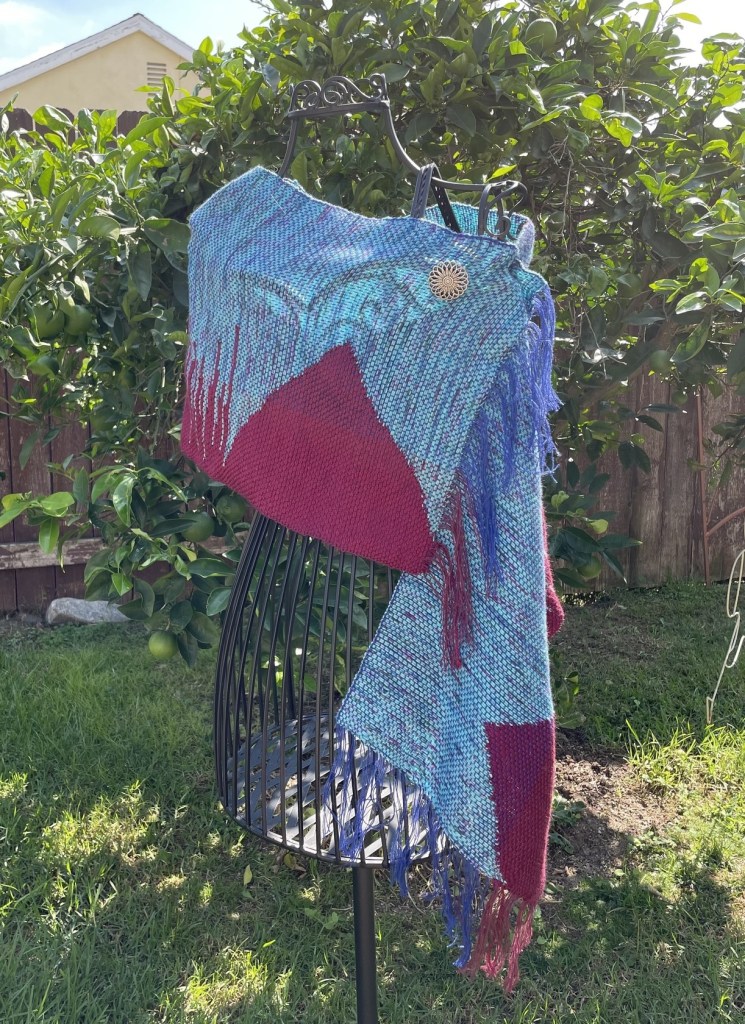
It’s such a thoughtful process—pairing yarns like companions, guided by instinct and season. Let’s talk about your approach to color harmony. Can you share an example where following your intuition over traditional color theory led to a surprising, beautiful result?
The choice of colors is probably one of my favorite parts. But then again, I do enjoy watching as the piece “grows” on the loom, and yet again, taking the piece off the loom is always a bit captivating.
Nonetheless, my fallback position is always in appreciating the color selection. Be it the brilliance of fall with gold and brown, the softness of spring, always the shadows of the blue sea, or the sheer whiteness of winter, all can be blended into a unique shawl, cowl, blanket or even tapestry, from wool to alpaca to linen to bamboo.
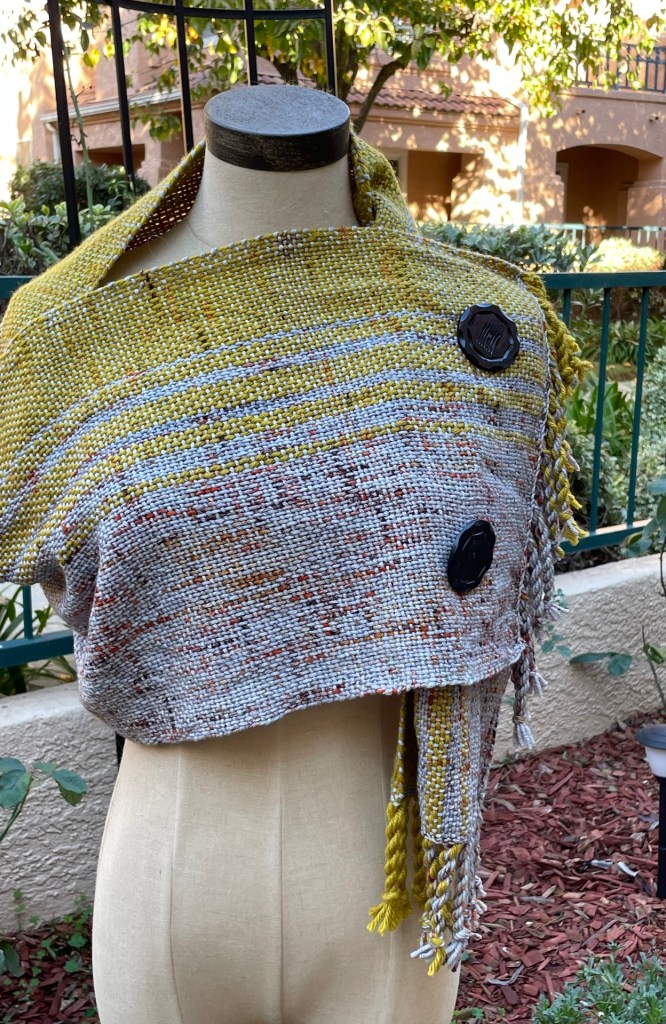
I did make a shawl that very unexpectedly surprised me. I found a brown wool, speckled with bits of orange. Using orange seemed natural, but so predictable. Simply too over-used. Instead, while chatting with a friend, we tried several colors and selected what the young woman at the yarn store called pickle green. It was the most unfamiliar shade of green that I had seen. Once woven in it was unique, yet pleasing. The shawl sold at an art show for 33% over asking price.
That “pickle green” moment really captures the magic of trusting your instinct—it’s wonderful how that unexpected choice not only worked visually but resonated with a buyer so strongly. Speaking of connection, you’ve presented your shawls at various exhibitions. What has been the most rewarding aspect of sharing your work publicly, whether online or in person? Have any viewer reactions stayed with you?
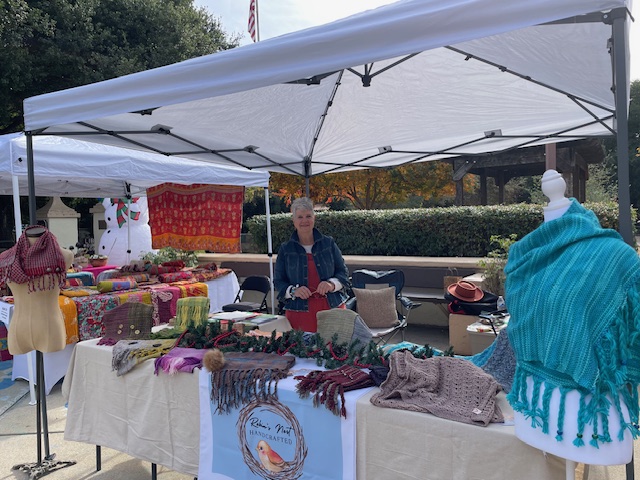
The most rewarding aspect of exhibition is “how far I’ve traveled” to show my work, from the beach to the mountains to 1000s of miles away. I am always excited to have someone try a piece one – a real, live mannequin. I set up at about 6 shows per year, as both an opportunity to sell my work, along with engaging in conversation. Plus, many people are unfamiliar with weaving, so that often starts a whole tutoring session.
It’s wonderful that exhibitions allow you to meet people and even spark curiosity about the art of weaving itself. When you’re not at shows, your photography plays a huge role in how others experience your shawls. How do you choose those beautiful outdoor backdrops? Do certain landscapes bring out different qualities in your work—say, a rocky shore versus a blooming garden?
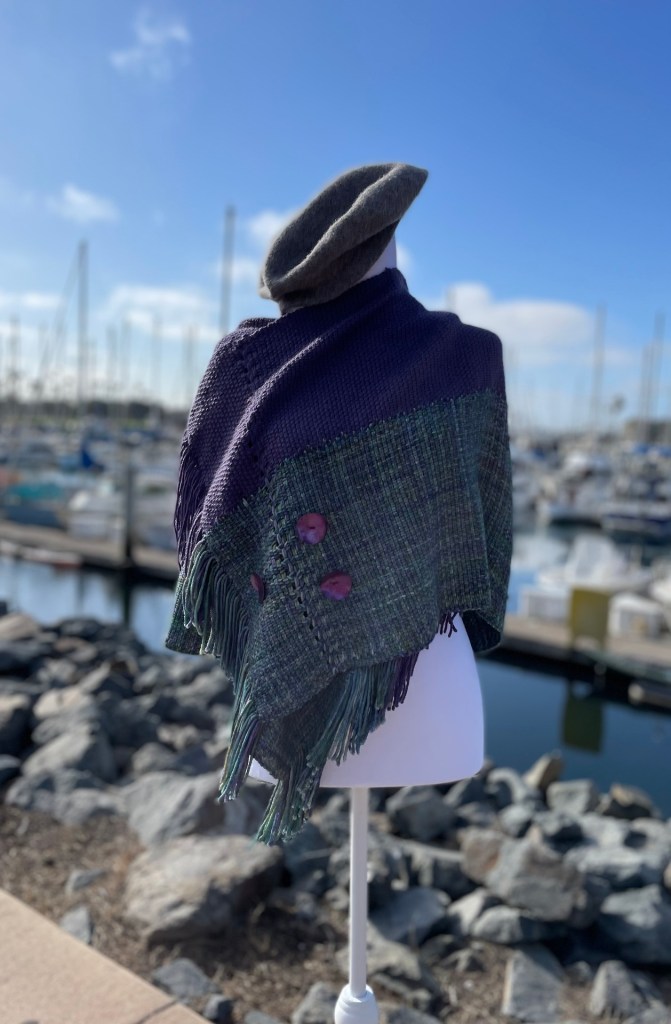
Why mess with perfection? Nature is perfect, ever changing and a display of hues. The problem is there is more nature than time to make shawls. And regardless of the weather, a shawl, a scarf or a wrap is always appropriate. I try to match the piece with the scenery. A quiet sandy beach quietly calls for blue. A recent green and pink piece I just photographed under a newly blossoming magnolia tree, and a pickle shade of green shawl nestled nicely in the yellow and purple pansies.
8. Your pairing of shawls and natural settings shows just how much intention goes into every detail. Beyond your creative process, I’m curious—does your background in fundraising shape the way you approach your fiber art journey today? Have you found ways to connect your artistic passion with community initiatives or charitable projects?

In my fundraising career I spent much time engaging with community members, donors, public audiences. But I’m never afraid to start a conversation. A looky-loo can often go from a shopper to a buyer while chatting about colors, weaving and where I produce my art.
I visit countless art markets each year, both to shop and sell, so investigating Christmas Markets in Germany, art exhibits along the coast, town fairs in France, and small shows are what I enjoy.

Some of my pieces, baby blankets particularly, have gone to victims of the recent wildfires in California. Charities have sought donated pieces for their silent auctions, museum associated-sales take a percentage of any sale to support their work, all good causes. I rely strongly on the edict of lending a helping hand, or as actress Audrey Hepburn stated, “We have two hands, one to help ourselves, and another to help others.” So stalwartly do I believe this.
Your connection to people and purpose shines through—whether in charitable giving or sharing your shawls, your art feels deeply rooted in meaning. On a more personal note—what does the act of weaving mean to you? Is it meditative, expressive, or maybe a way to hold onto a moment in nature before it slips away?
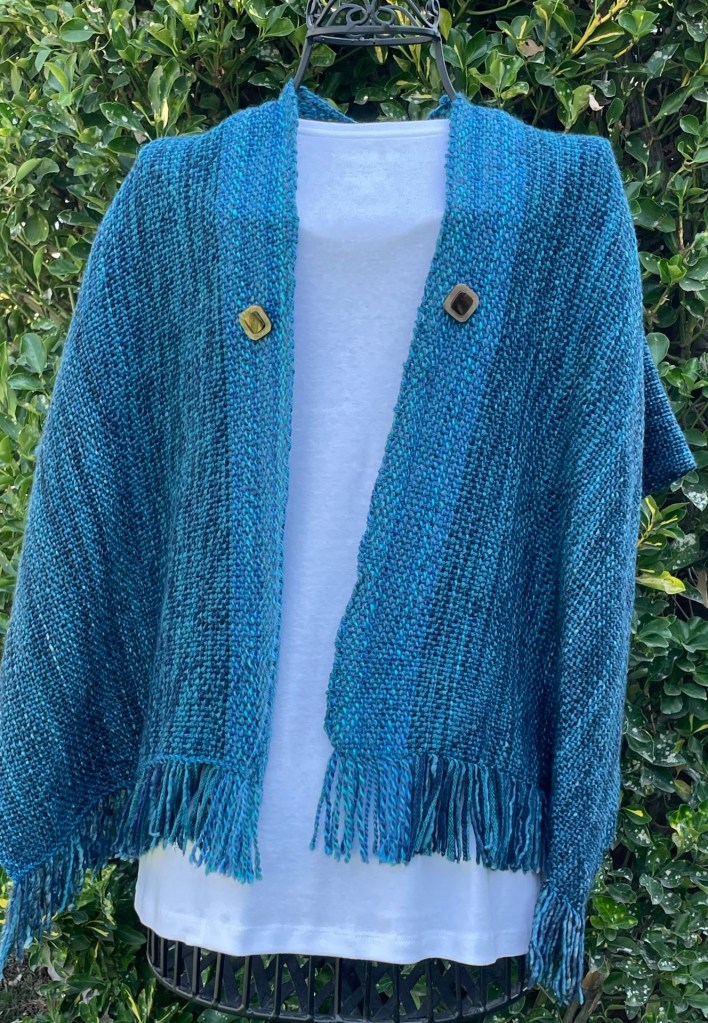
At the end of the day, finishing the last walk with the dog, after weed pulling in the garden, the weaving begins. Que the music, start a new audio book, say a prayer of praise to God, turn and face the sunset, sit on the patio, all are places to weave. Yet it is in the rhythm of the heddle (piece on the loom used to push or ‘beat’ the yarn), that is relaxing while bringing happiness in creation. Relax, let my mind wander.
That image of weaving as a moment of peace—whether on the patio at sunset or immersed in the rhythm of the heddle—captures the meditative heart of your process. As you look ahead, are there any new techniques or materials you’re eager to explore?
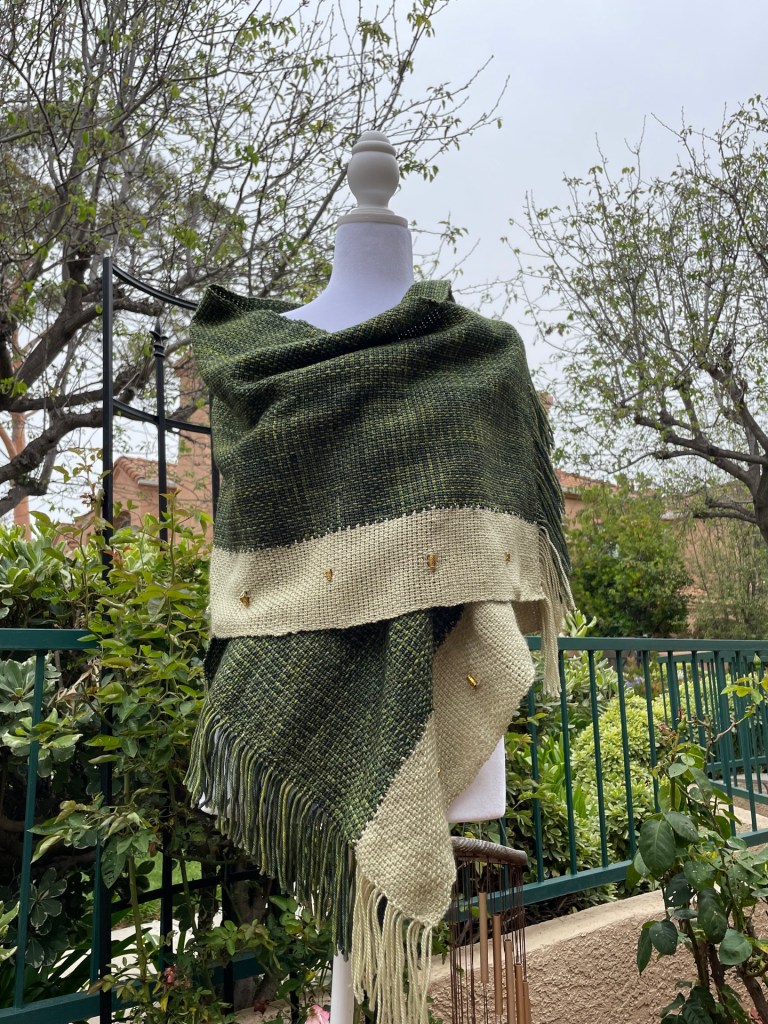
While in France I purchased several new yarns, new colors and new fibers, cotton/linen and linen/bamboo mixes. What to make, what adornments to add?
In my studio I have 18+ bins of yarn, each containing 5-8 bundles or skeins as they are technically called (In Europe they are referred to as hanks). Hours can pass as I mix, match, pick, enhance colors and techniques.
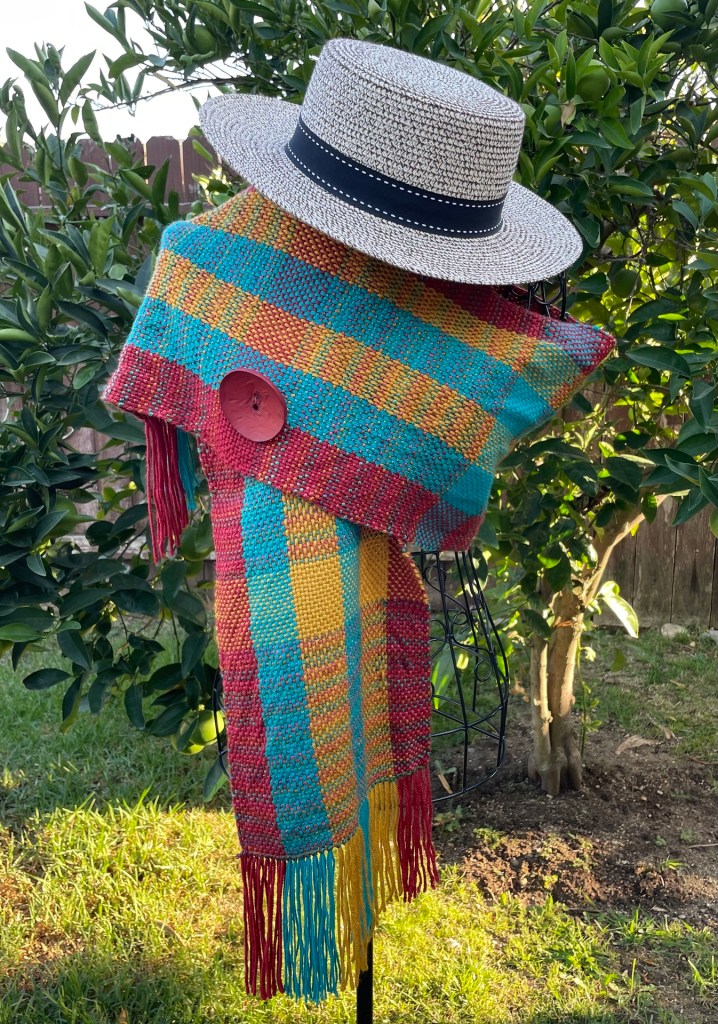
On monthly trips to one of my favorite yarn stores in California, with my dog along to seek out attention and pats on the head, I start the process of color mixing. Select a yarn color for a base, then find a subtle hue in the yarn to highlight or be a companion. Often my yarn selection is variegated, meaning it has multiple colors intertwined. Find one of the most obscure colors, go in search of a match. Then do I have beads or buttons or even charms to enhance the project? Thrift and antique stores offer great finds in buttons and other small pieces to attach. But be careful to not pick something too heavy that will weigh down or stretch the yarn.Always I’ve been tempted to try mohair but haven’t quite jumped on board.

Your creative process—from digging through bins of yarn to treasure-hunting for the perfect adornments—really shows how much thought and artistry goes into every shawl. For those who may see shawls as simply wearable items, how do you hope your work shifts that perspective toward seeing them as true works of art?
So much fiber, so little time! In my travels I love people watching. It is often a splash of color that says “I’m here and happy to be here.” Just like we tire of grey skies and love the crisp colors of fall, so should a scarf make you feel.
My black winter jacket, worn through countless American and European cities, pops with my woven purple and green scarf, with a touch of lace and accented with odd shaped black buttons. Come visit me and let’s brighten you day and your outfit with energetic colors, while making you smile!

That vivid splash of color—whether in a shawl or a smile—really becomes a joyful statement. In a world that often feels distant, how do you stay true to that spirit while finding visibility for your work? Have platforms like Biafarin, Exhibizone, or Gallerium helped you reach more people without losing that personal, vibrant touch?
Technology can’t replace a handwoven piece, but it can highlight colors and spread them around the globe. I have used multiple sites and channels to display my work. Sites like Biafarin, Exhibizone, and Gallerium both share my work while exposing me to others’ creativity. I have used all of these avenues and I am proud to have been featured on each one. I am challenged to keeping my Instagram account up to date with new designs coming off the looms. I am always in search of new outreach efforts.
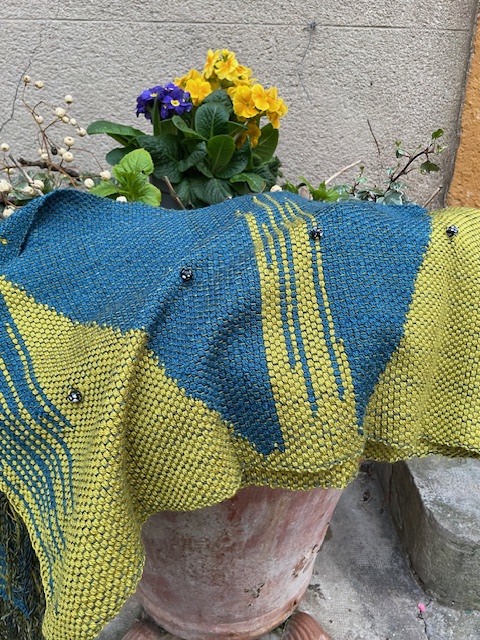
Your dedication to both tradition and innovation really shines through—blending handwoven craft with global platforms and outreach. Before we wrap up, is there anything else you’d like to share with readers about your journey, your inspirations, or what’s next in your creative world?
My journey to La Maison de Beaumont Internation Artist Resident exposed me to so much artistic creativity. All other residents were painters, so I was unique. Nonetheless, I returned with newly completed items, new skeins of yarn, and new designs for new projects!
To explore more of Robin McCarthy’s vibrant, handwoven shawls inspired by nature’s palette, follow her creative process on Instagram or visit her artist profile on Biafarin. Each piece reflects her deep connection to color, texture, and the beauty of the natural world—woven with heart, purpose, and a spark of joy.
 Review Me
Leave a comment