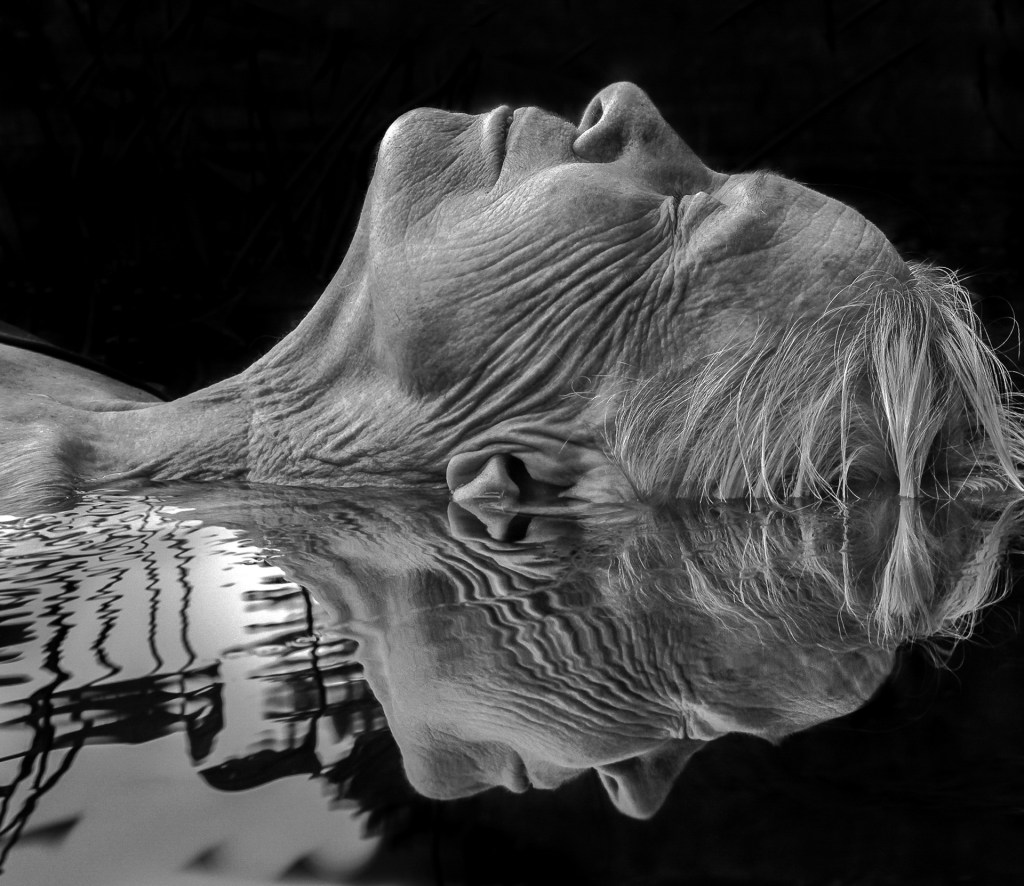
There are photographs that capture a likeness, and then there are those that dissolve boundaries—between subject and self, surface and soul, body and earth. In Markings, Karin Rosenthal achieves the latter. This hauntingly beautiful black-and-white photograph, selected for the “Passage of Life: Aging 2025” international exhibition by Exhibizone, is not simply a portrait. It is a profound meditation on aging, memory, and the silent dignity of surrender.
At first glance, we see an elderly woman, her face gently emerging from and mirrored in still water. The portrait floats between serenity and dissolution, blurring the line between the real and the reflected. The water acts not just as a medium of distortion but as a partner in storytelling. The ripples merge seamlessly with the wrinkles on her skin, creating a visual poem of time’s passage. This poignant metaphor elevates the image beyond portraiture into a universal reflection on aging.
Rosenthal’s subject, an 86-year-old woman, lies in the pond with eyes closed and spirit unbowed. Her posture is neither stiff nor performative. Instead, it is peaceful, open, and imbued with a quiet courage. The lighting, soft and diffused as if caressed by twilight, amplifies the emotional atmosphere of the scene. In this single frame, the viewer is drawn into a moment that feels suspended in eternity.
Emotionally, Markings evokes both reverence and vulnerability. The photograph honors the beauty of age not by disguising it, but by revealing it with grace and respect. The etched lines on the subject’s face speak not of decay but of endurance. They are not flaws to be hidden, but inscriptions of a life deeply lived. In the context of aging this work becomes especially resonant. It gently challenges a culture obsessed with youth, inviting us to see aging not as decline, but as return—a rejoining with the natural world that once gave us form.
From a compositional and technical point of view, Rosenthal demonstrates masterful control. Her long career in fine art photography, especially in abstract nudes reflected in water, has shaped a unique and evocative visual language. The decision to present the image in black and white removes all distraction, allowing the viewer to focus entirely on texture, light, and form. The symmetry of the woman’s profile and its reflection invites the eye to move fluidly across the frame, engaging not just with the physical image, but with its echo—its memory, its distortion, and its meaning.
The photograph’s title, Markings, is especially powerful. It refers not only to the physical wrinkles of age, but to the metaphorical imprints left by a lifetime—joy and sorrow, memory and forgetting, presence and absence. These are not random creases, but deliberate strokes on the canvas of time, each one whispering a fragment of an unseen story.
Rosenthal’s inclusion of water as a visual element adds depth and symbolism. Water becomes a collaborator in the narrative, fluid and shifting, symbolizing both transformation and return. In this way, the artwork aligns perfectly with Rosenthal’s broader artistic vision. Her work resists artificial constructs and instead pulses with organic truth. Over decades, she has forged a visual philosophy in which the body and nature are always in quiet conversation.
Perhaps the most striking quality of Markings is its honesty. There is no attempt to idealize the body or mask the reality of age. Yet, what emerges is strength. The woman in the photograph is not merely lying in a pond—she is surrendering to nature, merging with it, and radiating a deep inner dignity that is unmistakable.
Rosenthal’s contributions to photography have long been recognized by major institutions, collectors, and critics. Her works are included in over a dozen museum collections, and her exhibitions have helped reshape how we see the nude, the aging body, and the elemental harmony between form and earth. Markings, however, feels like a culmination of something more personal. It carries the wisdom of a seasoned artist and the empathy of a woman reflecting on her own passage of life.
As we move through our own aging journeys, this image offers more than aesthetic beauty—it offers clarity. It reminds us that we are not separate from the natural cycles we fear. We are part of them. Karin Rosenthal has not only given us a portrait of one woman’s courage. She has offered us a mirror to see ourselves, gently and truthfully, through time.
To explore more of Karin Rosenthal’s visionary work, visit her official website, follow her evolving journey on Instagram, or discover her artist profile on Biafarin.
 Review Me
Leave a comment