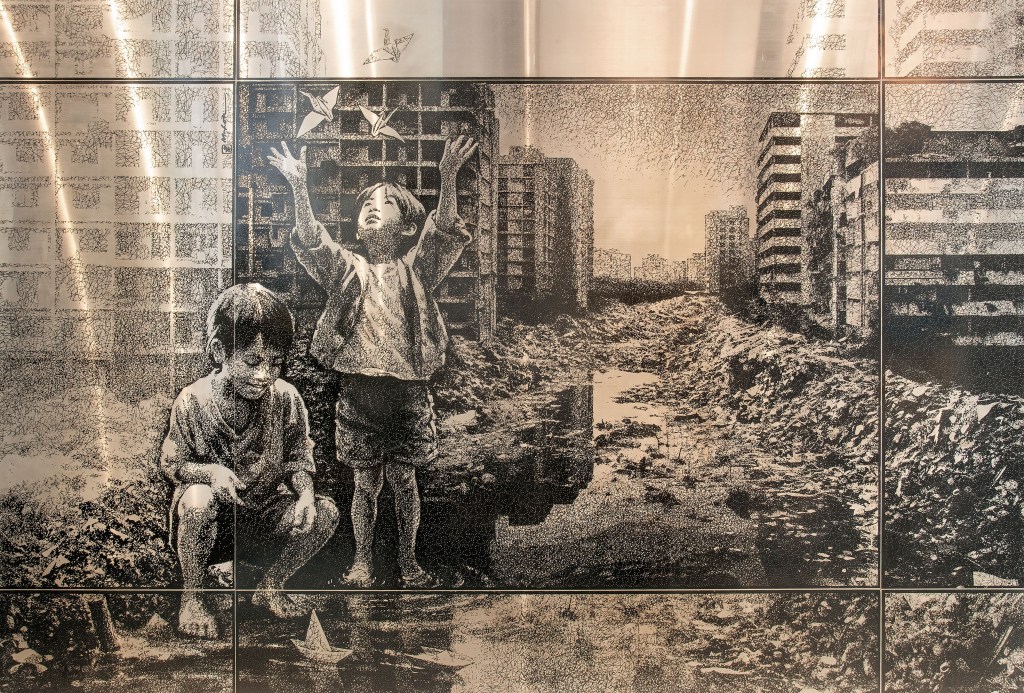
In Two Children, Vietnamese artist Mai Văn Nhơn channels a vision that is both harrowing and hopeful—etched not just into stainless steel, but into the viewer’s conscience. Selected for the 2nd Annual TOYS and JOYS 2025 international smart exhibition, this remarkable mixed media piece confronts the paradox of childhood innocence amid environmental and social decay.
Forged through the demanding medium of acid-etching on stainless steel, Two Children depicts two young figures amidst an urban wasteland—a barren riverbed, derelict buildings, and a skyline hollowed by neglect. Yet, this is not a portrait of despair. One child crouches gently near the water’s edge, gazing at a fragile paper boat afloat on murky waters. The other stands upright, arms lifted, releasing origami storks into the sky. It’s a scene suspended between collapse and ascension, realism and metaphor. The choice of acid-etched stainless steel is powerful—its permanence contrasts with the ephemeral childhood it captures, and its reflective surface reminds viewers of their own gaze, responsibility, and place in this narrative.
The grayscale palette—achieved through meticulous etching and contrast—serves as a visual echo of dystopia. Yet within this grayscale, there’s movement, light, and texture that evoke memory, time, and the passing of generational burden. Through layers of chaotic linework, Nhơn achieves a breathtaking intricacy—rubble becomes topography, buildings become monoliths of failure, and even shadows seem to whisper histories. The composition draws the eye across every inch, with the children as focal anchors, refusing to be lost in the desolation.
Thematically, Two Children finds its perfect place in TOYS and JOYS 2025. While the exhibition celebrates joy through play, Nhơn’s piece adds depth to this theme. It reminds us that the purest joys—like folding a paper crane or imagining a boat’s voyage—can emerge even in ruin. This is not joy as escapism, but joy as resistance. The paper boat, as Nhơn describes, becomes a metaphor for the fragile resilience of dreams. The storks, symbols of freedom and renewal, are not merely whimsical—they are calls to rise.
Nhơn’s artistic voice reverberates with social commentary. A master of mosaic and oil, here he redefines material and message. While he is best known for monumental works in ceramic—his contributions to the Red River Ceramic Road and the APEC leaders’ portrait mosaics—Two Children is a more intimate, yet equally monumental, artistic protest. It transforms steel into a living surface, where the innocence of play becomes a political act and environmental urgency finds expression through aesthetic grace.
What makes Two Children even more compelling is the sincerity of its symbolism. This isn’t a sanitized version of hope. It’s rooted in the tension between beauty and destruction, action and neglect. Nhơn Mai doesn’t shy away from visual discomfort; instead, he amplifies it so that the paper boat, the storks, and the children’s expressions glow even brighter. They are reminders of what we stand to lose—and what we can still protect.
As a visual manifesto, Two Children transcends medium and message. It is a plea, a poem, a prophecy. In the words of the artist himself: “Tradition is preserved only when it is reborn in new contexts.” Here, tradition—the enduring values of compassion, community, and care—takes shape in a contemporary language of steel and acid, childhood and decay.
To explore more of Mai Văn Nhơn’s compelling and socially engaged art, visit his official website, where his mosaic and mixed media works reflect a deep commitment to heritage and renewal. You can also follow his artistic journey through his Biafarin profile, where each creation speaks to his vision of art as a bridge between tradition and the future.
 Review Me
Leave a comment