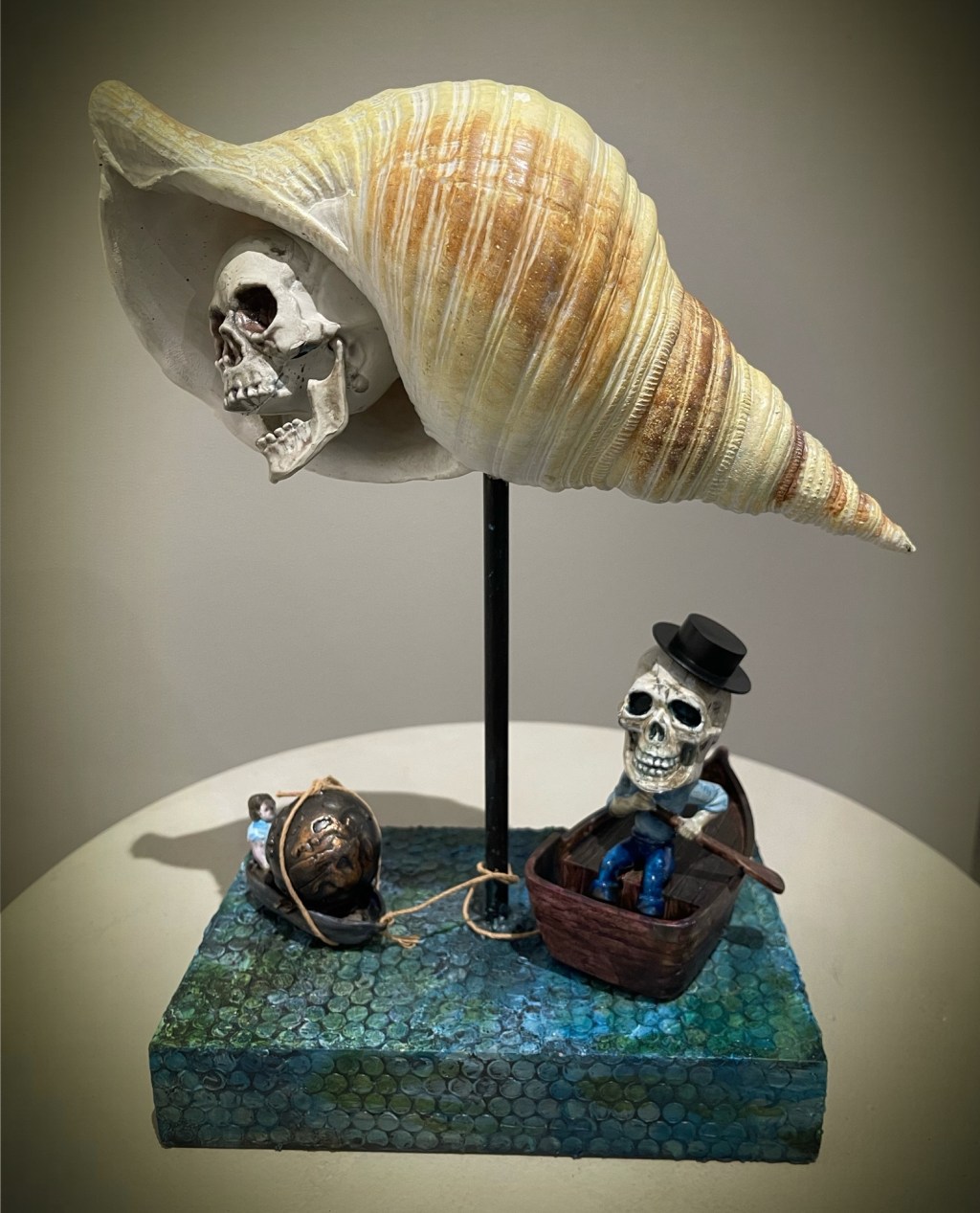
A spiral of bone and shell, a toy-sized skeleton rowing a boat, and a bound bronze sphere dragging behind—a strange and evocative scene unfolds in Diane Bywaters’ Our Children’s Inheritance. At first glance, it may appear whimsical or even playful. But linger, and its truth surfaces: this is no innocent fantasy. It is a grim fable about environmental legacy—what we pass on, and what we leave behind.
Constructed with epoxy clay, artificial shell, painted wood, metal rod, acrylics, twine, and repurposed toys, the assemblage becomes a compact theatre of consequence. Elevated at its center, a skull emerges from the mouth of a giant conch-like shell—part tomb, part trumpet of warning. Beneath, a skeleton in child’s clothing rows a wooden boat, dressed in cheerful blue pants and a black top hat, his empty gaze locked in silent resolve. To one side, tethered with twine, a child hauls a heavy, bronze-toned globe-like object in a toy vessel—a disturbing echo of innocence tasked with salvaging the ruined remains of the world.
This sphere, if seen as Earth, deepens the emotional gravity of the piece. Its worn, metallic sheen feels less like a living planet and more like a hollow artifact—no longer pulsing with life but scarred by human impact. That it’s pulled not by giants but by a child suggests the crushing imbalance of inheritance. The future generation must drag what past generations have neglected, wounded, and abandoned. It’s Earth not as a gift, but as a burden—strapped down, dulled, and barely buoyant.
Our Children’s Inheritance was selected for the Earth 2025 exhibition, a timely showcase of artworks reflecting environmental themes. Bywaters approaches the theme not with grand environmental vistas or abstract ecosystems but through a deeply personal lens—through toys, miniatures, and skeletons dressed like children. This intimacy is where the work’s power lies: it doesn’t just comment on climate change, it humanizes it. The cost is not theoretical. It’s our children’s joy, safety, and future at stake.
The choice of materials plays a vital role in conveying the message. The shimmering, textured base resembles polluted water, while the artificial shell gleams like something once beautiful, now calcified in memory. The twine that binds the Earth and the base feels crude and desperate, a makeshift lifeline knotted in panic. The skeleton’s attire—a child’s attempt at adulthood—evokes a forced maturity, a future generation expected to carry adult responsibilities in a world stripped of play.
Diane Bywaters brings to this work over 45 years of painting experience and 15 years of assemblage practice. A celebrated professor emerita and award-winning artist, she has more U.S. National Park artist-in-residencies than any other artist—an experience that intimately shaped her environmental consciousness. Her work doesn’t lecture—it narrates, with tenderness and quiet dread. This piece doesn’t shout catastrophe; it shows you a child dragging it.
What makes Our Children’s Inheritance unforgettable is its refusal to separate beauty from despair. There’s whimsy in the miniature, in the absurdity of a skeleton with a top hat. But that absurdity becomes tragic when you understand the story. It’s a requiem in the language of toys. A fable carved from the flotsam of neglect.
Bywaters reminds us that the Earth isn’t ours to own—it is something borrowed from the future. And unless we act now, the only inheritance we will leave is a decaying world, wrapped in twine, dragging behind a child who deserved better.
Bywaters’ voice, both as an artist and environmental witness, continues to resonate across mediums and platforms. Her multidisciplinary work can be explored further through her official website, where her portfolio reveals the depth of her artistic inquiry. On Instagram, she shares glimpses into her studio life and creative process. She also maintains an artist profile on Biafarin, offering collectors and curators a closer look at her evolving body of work through her page here.
 Review Me
Leave a comment