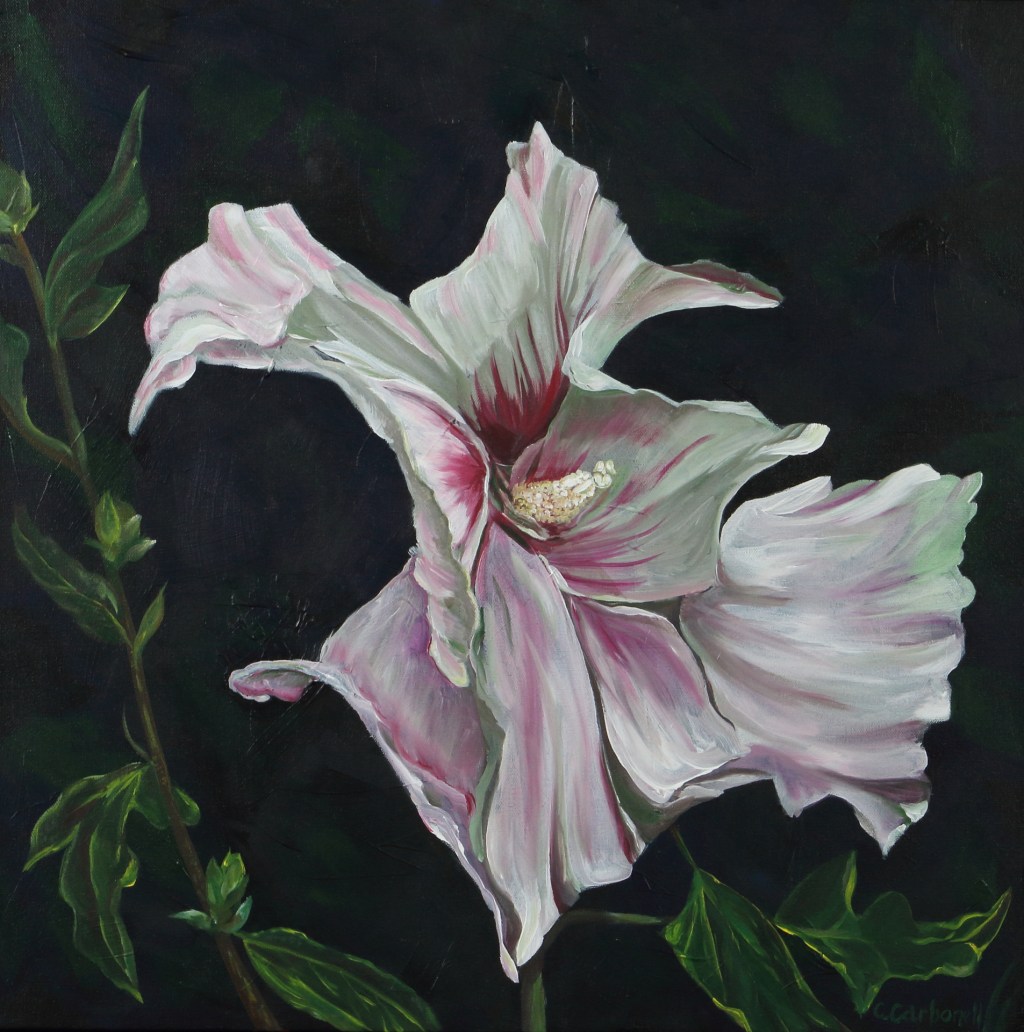
Happiness often arrives not in grand declarations, but in the hushed bloom of beauty—a single flower unfolding in stillness, yet brimming with vitality. Chelsea Carbonell’s Dancing Hibiscus, a 24×24-inch acrylic painting on canvas, captures precisely that kind of joy: gentle, graceful, and rooted in presence. Showcased in the 5th Annual Happiness 2025 international smart exhibition, this work offers a profound reflection on the power of subtle wonder to elevate the human spirit.
At first glance, the painting feels like a quiet revelation. Set against a dark, velvety background, the hibiscus emerges with luminous softness—its delicate pinks, creamy whites, and gentle lilac tones folding and twisting like silk in motion. Each petal carries a sense of choreography, as if the flower were mid-dance, lifted by an unseen breeze. Carbonell’s choice of title is no metaphor—the hibiscus truly dances, with every line, curve, and color humming in harmony.
The composition is centered, yet never static. The flower commands the canvas with organic elegance, while tender stems and green foliage edge into view like supporting cast members in a solo performance. There’s a palpable sense of life here—not just botanical life, but emotional life. The movement in the petals feels spontaneous yet intentional, the brushwork fluid but precise. Carbonell balances discipline with freedom, crafting a moment that feels as natural as it is composed.
Color plays a central emotional role in this piece. The artist’s masterful modulation of pale tones against the shadowy background creates an atmosphere of serenity and illumination. The cool, soft greens of the leaves provide contrast without distraction, allowing the petals’ inner flush of pink to pulse with warmth. The dark ground behind the flower doesn’t obscure—it amplifies, letting the bloom radiate with quiet confidence.
Carbonell’s artistic voice is deeply shaped by her lifelong relationship with nature. Raised among the redwoods and waves of Northern California and now residing in Washington State, she speaks the language of landscapes and blooms with fluency and reverence. Her background in fine art and psychology deepens her ability to observe and translate the subtle emotional textures of the world. In Dancing Hibiscus, this sensitivity is on full display—the flower becomes not just a botanical study, but a vessel for feeling.
Her statement, “I try to recreate that sublime feeling,” echoes through the work. Indeed, Dancing Hibiscus does not demand happiness—it reminds us of it. It is the joy of quiet contemplation, of still mornings and sun-dappled afternoons. In a world often overwhelmed by noise and haste, this painting whispers an invitation: slow down, look closely, feel deeply.
It’s a joy Chelsea Carbonell also shares beyond the canvas. As an art educator guiding over 70 children weekly, she nurtures new eyes to see beauty—and to create it. Her work, both as an artist and mentor, sows seeds of creativity and appreciation, mirroring the flower that blooms so gracefully in this painting.
To discover more about the artist and her work, visit her website, follow her on Instagram, and view her Biafarin profile.
 Review Me
Leave a comment