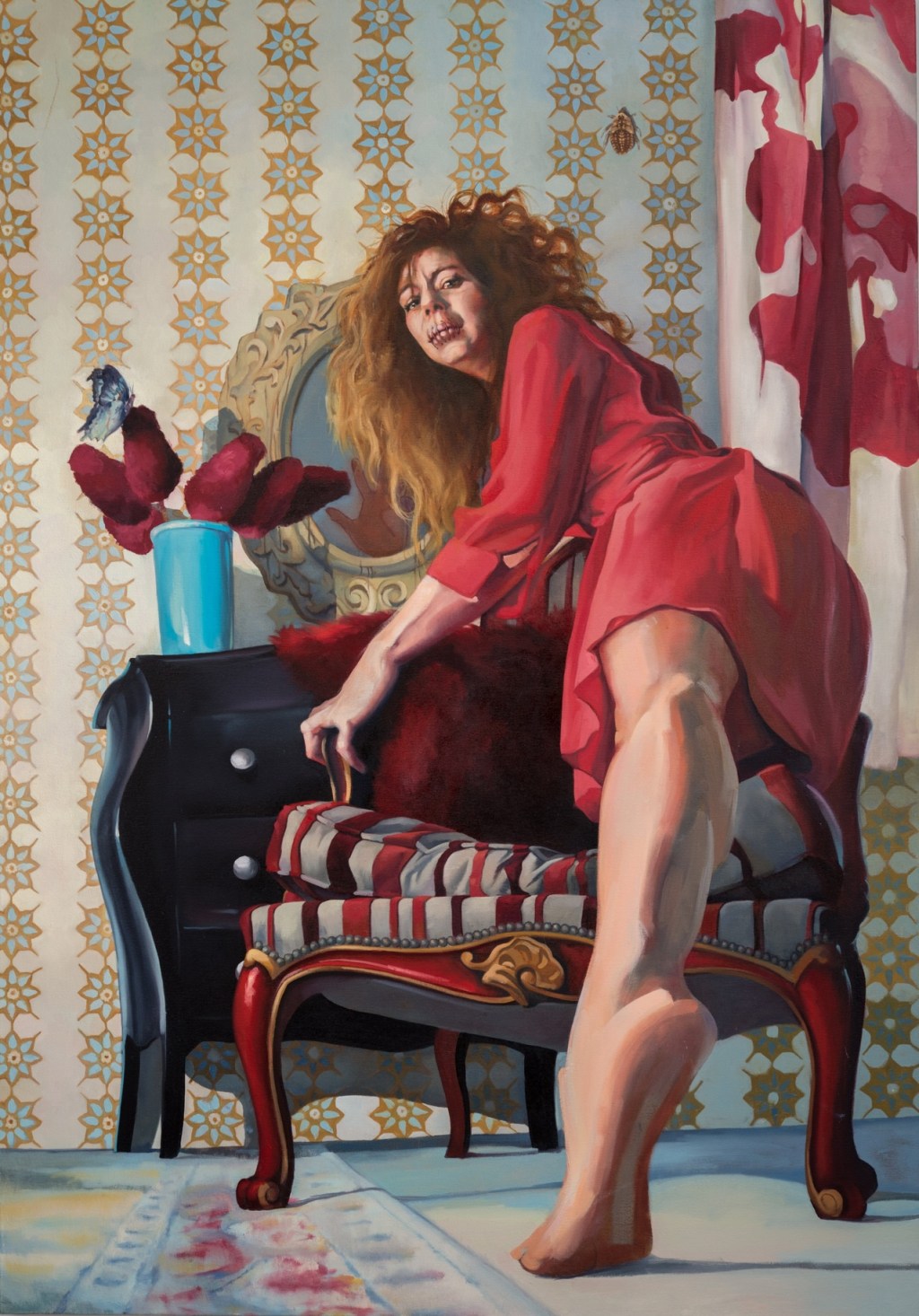
In Censored, a gripping oil painting by Gaetanne Lavoie showcased in the Woman 2025 international smart exhibition, the viewer is met with an artwork image that is both visually commanding and psychologically unsettling. This powerful work confronts the quiet, internalized censorship that women often impose upon themselves—an invisible but deeply rooted dynamic that resonates profoundly within the broader theme of Woman 2025: the exploration and celebration of womanhood in its complexity, vulnerability, and power.
The composition is deliberate and theatrical, echoing the tension and stylization of Film Noir—a genre Lavoie cites as her inspiration. A woman, clad in a flowing red dress, bends forward in a position that feels both exposed and alert, her face twisted with conflicting emotion. Her eyes glisten with the threat of tears—wide, watchful, and vulnerable—while her mouth, disturbingly rendered as though sewn shut, delivers a visceral metaphor of silencing. These haunting facial details are impossible to ignore, evoking a deep sense of suppression, fear, and entrapment. They raise an unsettling question: is she being silenced, or has she been the one stitching her own voice closed?
The mirror behind her shows a hand—ambiguous and ghostlike—reaching toward her. Is it her own hand from another angle, a figment of her paranoia, or the manifestation of internalized judgment? Lavoie masterfully plays with this ambiguity, making the mirror not just a reflective surface but a symbolic portal into the fractured psyche.
Color plays a critical role in amplifying the emotional stakes. The red of the dress commands attention—passionate, powerful, but also perilous. It contrasts sharply against the ornate yet claustrophobic wallpaper and the chilly elegance of the teal vase, creating a dissonance that mirrors the conflict within the subject. A richly textured carpet, lush velvet pillows, and ornate furnishings root the piece in a domestic interior, yet the psychological atmosphere is anything but comforting.
Lavoie’s technical prowess is unmistakable. Her use of oil on canvas is confident and meticulous. Flesh tones are rendered with a sculptural depth, while the drapery and upholstery boast tactile realism. The perspective is daring: the upward gaze exaggerates the model’s stature and vulnerability, immersing the viewer into her space and mental state. These choices reflect Lavoie’s deep academic training, earned through two MFA degrees, and refined through her extensive experience as both a practicing artist and educator.
What makes Censored particularly resonant within the Woman 2025 exhibition is how it subverts traditional depictions of femininity. Rather than presenting the woman as subject to censorship from outside forces alone, it asks a deeper, more disturbing question: how often do we participate in our own silencing? Through her sewn lips, moist eyes, and paralyzing uncertainty, Lavoie compels us to re-examine agency, fear, and self-sabotage in the female experience.
Gaetanne Lavoie continues to push the boundaries of narrative figuration, drawing from cinematic, psychological, and feminist influences. Her voice is bold, her execution is refined, and her vision is unapologetically layered. As viewers, we are invited not just to witness but to confront the mirrors in our own lives.
To discover more of Gaetanne Lavoie’s work, visit her website at gaetannelavoieart.com, her Biafarin profile, or follow her on Instagram at @gaetannelavoieart.
 Review Me
Leave a comment